.jpg)
A high-throughput orchestra of robots and readers
The automation engine driving reliable data at the VIB Screening Core
The VIB Screening Core operates an intricately linked platform of advanced technologies designed to execute complex screens in a high-throughput, low-variability manner. However, beneath the swinging robotic arms and high-content microscopes lies a broader capability obscured by the name "screening core" itself. Drawing on nearly two decades of technical experience from Dominique Audenaert, Long Nguyen and their colleagues, the core actively deploys its hardware to automate everyday laboratory liquid handling bottlenecks that are not necessarily connected to traditional perturbation screening. For scientists struggling with manual standardization or sample volume, the core offers an immediate, automated reality.
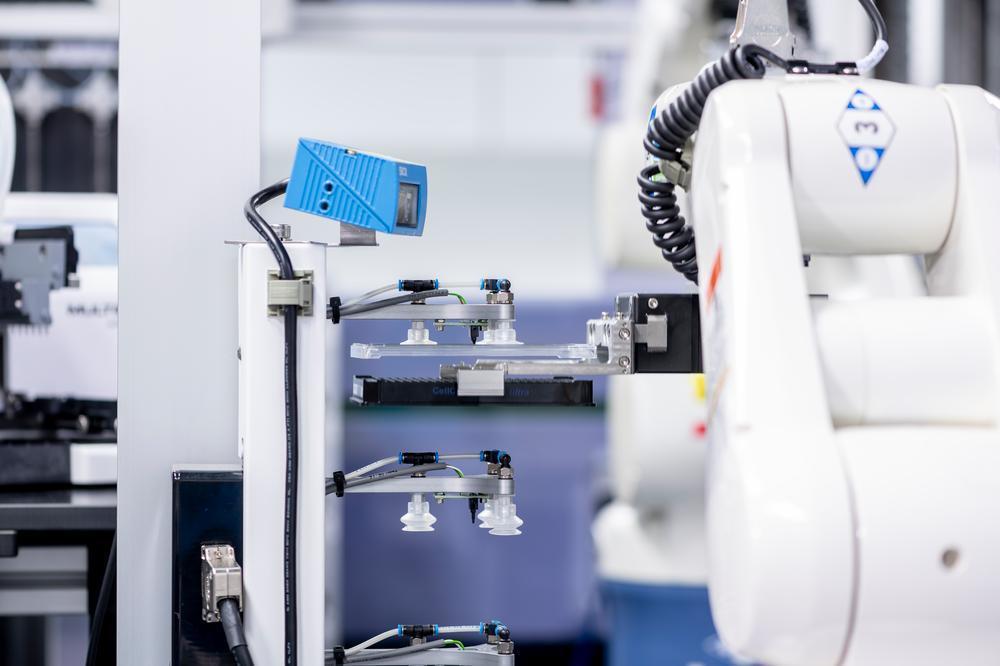
At its busiest, the VIB Screening Core is a place of constant motion. Robotic arms swing purposefully, ferrying barcoded plates between devices, while liquid handlers dispense fluids through ninety-six heads at once. A series of specialized non-contact dispensers deploy clever technologies to eliminate traditional tip-based pipetting entirely, reducing the risk of cross-contamination. One machine uses focused sound waves to eject precise 2.5-nanoliter droplets directly into a well. Another uses a pressurized environment and micro-valves to shoot bulk liquids from microliter to nanoliter range across an entire plate in seconds. By removing the traditional tip from the equation, the platform drastically accelerates the pace of high-throughput screening.
A supporting cast of specialized machines completes the orchestra. Automated incubators regulate temperature and CO2 for mammalian cell cultures, while a storage hotel stacks the necessary consumables. To refresh growth mediums, a clever specialized reverse-centrifuge machine gently floats the liquid away, replacing standard needles that might have disturbed delicate cell monolayers. At the end of the line sit high-throughput microplate readers measuring fluorescence, luminescence, and optical density across the samples. Simultaneously, an automated high-content microscope can image every single well of a 384-well plate. Specialized software then transforms the raw visual data into quantifiable metrics. An integrated scheduling software acts as the conductor for this entire end-to-end process. By coordinating every plate with absolute precision and timing, the system reduces experimental variability and guarantees rigorous, robust and highly reliable data.
Before the robots took over
The operation looked entirely different two decades ago. Long Nguyen joined the facility when it was established in 2007. He originally trained as an industrial engineer before completing a master's degree in biotechnology. A chance encounter with Dominique Audenaert in the corridor—just as Long was job hunting and Dominique was establishing the core—led to his appointment.
"I was very interested in the technical part of biotechnology and lab work," Long recalls. "It was a perfect position for me because it combined the technical part and the science part".
In those early days, the facility operated with very few machines. Their first major project involved screening Arabidopsis seedlings in 96-well plates. The team seeded the plants in a liquid medium, grew them for several days, and manually added various compounds to test for promoter activation. Every step of this meticulous process was executed entirely by hand using a standard multi-channel pipette.
Their first foray into automation was a basic liquid handler, a machine capable only of copying liquid from one multi-well plate to another to slightly increase throughput and add consistency and efficiency. Over time, they added more standalone liquid handlers to their arsenal. Around 2015, the core took its first major step toward true high-throughput automation by integrating these standalone devices into a single, comprehensive screening platform driven by scheduling software.
Long does not miss the days before the robotic arms took over.
“We had to manually change the plates all the time. We were more or less the robotic arms at that moment,” he notes with a smile.
Today, complete platform integration guarantees precise timing and strict standardization across experiments. This consistency is critical. A single screening campaign generates baseline data that research groups will rely on for years, making the absolute quality and reproducibility of that initial data paramount.
.jpg)
.jpg)
.jpg)
A core with expertise to spare
The VIB Screening Core's platform and expertise extend far beyond traditional screening. As Long explains, a compound screen is a months-long campaign involving assay optimization, miniaturization, and validation. Once complete, the resulting data can fuel a research group for years, meaning labs do not return every month for new screens. In between these massive screening campaigns, the core's automated machinery and highly specialized staff are available to solve entirely different scientific bottlenecks.
"We have many of the devices needed for liquid handling automation available," Long explains. "People come to us and say, 'We need this automated, but it's not for a screening. Can you do that?' Sure. Why not? We are here to help you."
So what do non-screening projects that benefit from automation look like? Long points to a project where they optimized a high-throughput plasmid extraction workflow. Plasmid extraction is an everyday, fundamental task for researchers, but it becomes a massive bottleneck when a project demands a high volume of samples. A research group approached the core with exactly this problem: their required throughput was practically impossible to achieve by hand. Instead of relying on manual labor, the core programmed a standalone liquid handler to automate the entire extraction process across 96-well plates. The machinery now manages the repetitive steps—breaking the cells apart, binding the DNA, washing away impurities, and eluting the final clean product. It is a perfect demonstration of the facility's value: taking a common task that scientists must do repeatedly and scaling it into an automated and high-throughput workflow.
This collaborative, problem-solving approach naturally extends across VIB. The Screening Core has utilized its machines and expertise to help the VIB Flow Core to improve the speed and efficiency of their own complex workflows.
State-of-the-art physical machinery is how the Screening Core currently delivers this immense value, but Long keeps a close eye on the horizon. While new physical hardware like microfluidics continues to enter the market, the core recognizes that generating high-throughput results creates a new bottleneck: making sense of the output. To push their capabilities even further, the next frontier will require new technologies capable of analyzing data faster and more effectively, automating by building on the human expertise at hand.
The advent of artificial intelligence
As the landscape of scientific automation continues to shift, Long views artificial intelligence as the immediate tool to handle this data influx. While the core excels at automating physical workflows, processing the massive amounts of visual data generated by the high-throughput imaging microscope currently relies heavily on human expertise.
At present a human operator must carefully teach the algorithm how to segment individual cells, pinpoint specific spots within the cellular structure, and accurately measure their intensity. Long anticipates that machine learning will soon handle this analytical heavy lifting. Instead of relying on an operator to set narrow, rigid parameters, a trained AI model could learn to independently classify a sample as positive or negative, weighing vastly more variables simultaneously than a human ever could consider.

How the Screening (and automation) Core can help
For scientists throughout the VIB network, the Screening Core offers a straightforward value proposition. "If you are doing something manual at the moment and you need higher throughput, or you have something that is very variable, think about automation," Long advises. By partnering with the core, researchers can drastically reduce experimental variance and enhance assay robustness, ensuring precision, accuracy, and timing across every plate.
The facility also provides a practical solution to a common inefficiency in academic research. Long frequently sees laboratories secure funding and purchase expensive machines for highly specific projects, only for the machines to fall into disuse soon afterwards.
"They get the funding, they buy a panel and perhaps they let the company write a script for them. But then after that project, it's standing there and collecting dust. I find it a shame because these are not cheap devices. A big part of automation is the expertise of the people that have to handle it, and that part is being forgotten".
This is where the Screening Core steps in to unlock a machine's holistic value. The team is willing to deploy their deep operational knowledge to rescue neglected equipment and adapt it for new, diverse workflows.
"Maintaining and operating machines elsewhere is not our core business," Long notes, "but if we can help, then we are always happy to do so".
Ultimately, transforming a manual facility into a highly automated screening platform has left Dominique, Long and the whole Screening Core team with a rare depth of operational knowledge. For scientists ready to scale their own research, that accumulated expertise represents an immense resource.