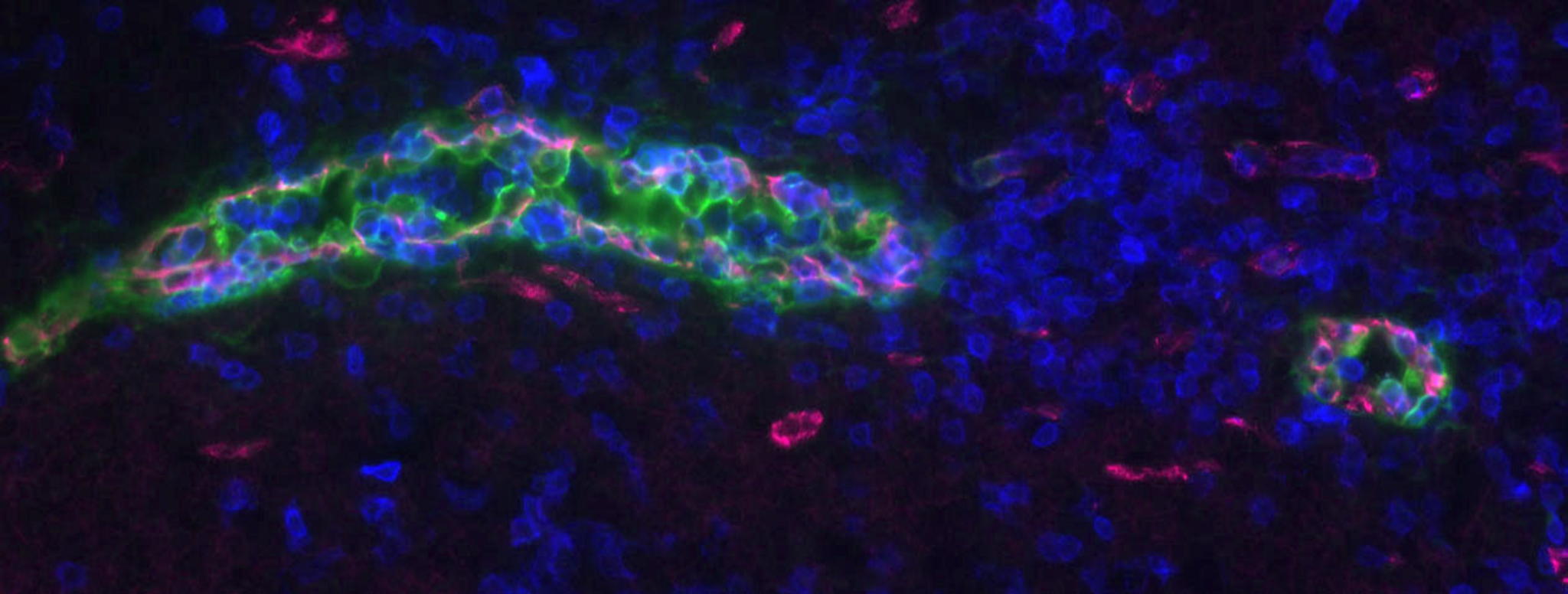
.jpg "A high endothelial venule or HEV.")
Building a new class of immunotherapy
The journey from a VIB discovery to a clinical-stage program at Mestag Therapeutics
Few discoveries make the journey from a biological observation in the lab to a therapy tested in patients. The collaboration between the Bergers lab at VIB-KU Leuven, VIB Discovery Sciences and Mestag Therapeutics is one such example.
More than a decade ago, Prof. Gabriele Bergers and her team at the VIB-KU Leuven Center for Cancer Biology set out to better understand how blood vessels and immune cells interact inside tumors. What began as a fundamental question in tumor biology led to the discovery of a mechanism that could help overcome one of the biggest challenges in cancer immunotherapy: how to bring effective immune responses into tumors that largely remain invisible to the immune system.
Today, that discovery has evolved into MST-0312, a bispecific antibody being developed by UK-based biotech company Mestag Therapeutics. In May 2026, the program reached a major milestone when the first patient was dosed in the Phase I STARLYS clinical trial, evaluating its potential as a novel therapeutic strategy for patients with advanced solid tumors.
Discovering a new route into the tumor
Not all tumors are equally visible to the immune system. Some contain large numbers of immune cells and respond relatively well to immunotherapies. Others, often referred to as 'cold' tumors, contain few immune cells and are much harder to treat.
Understanding this difference became a central focus of Bergers' research.
"We've been studying the interaction between blood vessels and immune cells in tumors for many years," says Bergers. "A few years ago, we found that we could therapeutically change tumor blood vessels from being a barrier with immunosuppressive features into a vascular structure that actively promotes the entry of immune cells into tumors."
The breakthrough emerged while studying tumors treated with a combination of anti-angiogenic therapy and immune checkpoint inhibition. Bergers' team noticed unusual blood vessels at the tumor rim that were surrounded by lymphocyte clusters. These structures turned out to be high endothelial venules, or HEVs, specialized blood vessels normally found in lymph nodes and other lymphoid tissues.
Their presence was particularly intriguing because the vessels were associated with tertiary lymphoid structures (TLSs), organized clusters of immune cells that function as local centers for immune activation.
For Robert de Jonge, Chief Business Officer at Mestag Therapeutics, the significance of these structures is striking.
"TLSs are local immunity hubs that facilitate the recruitment, education, and activation of immune cells directly within tissues. Over the last few years, a large body of clinical evidence has shown that both TLSs and HEVs are associated with improved patient outcomes and better responses to therapy across cancer types and stage of disease."
The findings suggested that these structures were not merely markers of an active immune response. They might actively contribute to it.
Identifying the biological trigger
The next challenge was understanding how these specialized structures form inside tumors.
Using advanced genetic and single-cell approaches, Bergers' team showed that the lymphotoxin-beta receptor (LTBR) signaling pathway can transform ordinary tumor blood vessels into HEVs and stimulate the development of TLSs, creating an environment that attracts and supports immune cells.
For Bergers, the therapeutic implications were immediately apparent.
"By converting the lymphocyte barrier function of the tumor vasculature into a structure that promotes lymphocyte influx, we believed this could be particularly powerful for immune-deserted tumors where very few T cells are present. That led to the idea that an LTBR agonist could potentially be used therapeutically to boost anti-tumor immunity."
At the time, the concept was highly novel. While many immunotherapies focus on boosting immune cells already present in tumors, this approach aimed to help bring immune cells into the tumor in the first place.
Turning biology into a therapeutic opportunity
Moving from biological insight to a therapeutic concept required expertise beyond cancer biology.
This is where VIB Discovery Sciences became involved, VIB’s in-house drug discovery unit. Working closely with the Bergers lab, the team began developing molecules capable of activating LTBR in a controlled and therapeutically meaningful way. A crucial element of that effort was the Nanobody® platform1, one of Belgium's best known biotechnology innovations.
"Nanobodies are the smallest naturally occurring antigen-binding domains derived from camelid antibodies," explains Bruno Dombrecht, Head of VIB Discovery Sciences. "They are exceptionally versatile and robust proteins that can be combined like Lego blocks to create highly sophisticated therapeutic molecules. In this case, that flexibility allowed us to explore many different designs and identify molecules that were active enough to drive the desired biology, but inactive when and where they shouldn't be."

(@VIB-IneDehandschutter, @Mestag Therapeutics)
Achieving that balance was critical. The molecules needed to activate LTBR inside tumors, while minimizing activity elsewhere in the body. Reaching the right combination required extensive engineering, biological testing, and continuous iteration.
Dombrecht also emphasizes that the project brought together experts with very different perspectives.
"Cancer biologists, antibody engineers, and drug developers all speak slightly different scientific languages. One of the strengths of this project was bringing those disciplines together around a common goal."
Finding the right partner in Mestag Therapeutics
As the program matured, VIB Innovation & Business began evaluating how best to advance the technology towards patients.
At the same time, Mestag had deep expertise in TLS biology through its founders, who are world leading academics in fibroblast immunology, and had been studying TLS outside of cancer for decades. Mestag saw the opportunity to use the power of TLS & HEV to drive anti-tumor immunity and set out to design a drug to help form these structures in tumors. The scientific rationale behind the VIB program strongly aligned with the company's strategy.
When the two organizations connected, the fit was clear. "Three things immediately stood out," says de Jonge. "First, the binders developed by Bruno and his team were of exceptional quality. Second, the project had reached the right stage of maturity for us to build on and accelerate our work in this area. And third, collaborating with a world-leading expert in tumor vascular biology, Gabriele Bergers provided a tremendous advantage."
The partnership was formalized in 2023 through a license agreement that gave Mestag access to VIB's panel of LTBR-targeting nanobodies.
For both organizations, the partnership represented more than a licensing transaction. It reflected a shared commitment to advance a promising new therapeutic concept through development and toward the clinic as efficiently as possible.


Designing MST-0312
The collaboration ultimately resulted in MST-0312, a bispecific antibody designed to selectively activate LTBR within the tumor microenvironment, inducing the formation of TLSs and associated HEVs in tumor tissue. One arm of the molecule targets LTBR, while the other binds fibroblast activation protein (FAP), a marker highly expressed in tumor tissue.
The strategy allows the therapy to concentrate its activity precisely where it is intended to act.
"We wanted to activate LTBR specifically inside the tumor microenvironment and not elsewhere,” explains De Jonge. “FAP is highly expressed in tumor stroma but largely absent from healthy tissues, making it an ideal targeting mechanism.”
The resulting therapeutic is designed to induce TLSs and HEVs in tumors, transforming poorly infiltrated tumors into environments capable of supporting more potent immune responses. According to De Jonge, access to the VIB antibody panel helped bring the program to patients faster.
Reaching the clinic
In May 2026, MST-0312 entered the clinic when the first patient was dosed in Mestag's Phase I STARLYS trial. For a program that originated from a biological observation in an academic laboratory, the milestone marked a significant step forward.
“The biggest milestone any drug discovery program can achieve is dosing the first patient,” says De Jonge.
The trial is evaluating safety, tolerability, pharmacokinetics, pharmacodynamics, and early signs of anti-tumor activity, both as a standalone treatment and in combination with the checkpoint inhibitor pembrolizumab. The therapy will initially be evaluated in tumors formed in barrier organs, including breast, lung, colorectal, skin, and bladder cancers.
Built on shared conviction
MST-0312 still has a long clinical development journey ahead. Yet the program already illustrates how breakthrough science advances when the right expertise comes together. A biological discovery in the Bergers lab was combined with antibody engineering at VIB Discovery Sciences, supported by VIB Innovation & Business, and expertly incorporated into MST-0312 by Mestag’s team of drug developers and clinicians, to result in a now clinical-stage program.
Dombrecht reflects, "The science was novel and ambitious. What made this project work was finding the right partner sharing the same belief to turn this into an entirely new therapeutic approach together."
And De Jonge summarizes, "Mestag and VIB are pioneering an important new therapeutic class in the fight against cancer."
[1] Nanobody® is a registered trademark of Sanofi.