Measuring how proteins interact in their natural habitat
A deep dive into FLIM-FRET and the QF Pro® workflow
Modern cell biology is full of interaction maps. We can pull down complexes, run mass spectrometry, and build networks that suggest who touches whom. But those approaches often share the same blind spot: they turn tissue into a homogenate. You learn that an interaction exists somewhere in the sample, but you lose the spatial and cellular context that often makes the mechanism understandable.
That tension is what drew Eef Parthoens (VIB BioImaging Core Ghent) toward functional microscopy. “A lot of people study protein-protein interactions by doing co-IP or mass spec on lysates,” she says. “That gives you an answer, but it’s an averaged answer. What we can do with microscopy is ask: where in the tissue does this happen? In which cells? In which compartment? I think many researchers underestimate what we can do in this regard at the BioImaging Core.”
This article takes a technology-focused look at Fluorescence Lifetime Imaging Microscopy (FLIM) and how it becomes a quantitative readout for protein proximity through FRET. It also zooms in on a practical workflow that has recently gained traction at VIB: QF Pro®, developed by HAWK, which combines two-site immunofluorescence with amplified FRET-FLIM to quantify protein interactions directly in fixed tissue. For the BioImaging Core, it has become both a success story and a gateway into a broader conversation about what “functional imaging” can mean in an institute that is rapidly embracing spatial biology.
Moving beyond intensity in complex samples
Most fluorescence microscopy measures intensity, and intensity is a fickle signal. It shifts with fluorophore concentration, illumination inhomogeneity, staining efficiency, tissue thickness, and photobleaching. Autofluorescence can swamp your signal in organs like the liver. For qualitative imaging, that may be manageable. For quantitative inference about molecular events, it becomes a problem.
FLIM takes a different approach. Instead of measuring the fluorescence intensity, it measures how long a fluorophore remains in its excited state after a pulsed laser excitation. That number—the fluorescence lifetime, expressed in nano or picoseconds—is surprisingly stable and often far less sensitive to the usual sources of intensity artefacts.
“The strength of lifetime is that it’s a physical property,” Eef explains. “Instead of asking how much signal you have, you’re asking how the fluorophore behaves. That makes it much more robust when samples are challenging.”
That robustness is also why FLIM is still relatively rare in practice. It requires dedicated hardware for time-resolved detection, pulsed excitation, and analysis workflows that go beyond standard confocal imaging. “You can’t do FLIM on every confocal microscope,” Eef says. “In Belgium, there are only a handful of systems with a proper FLIM module, and you need the right setup and the expertise to make the measurements reproducible.”
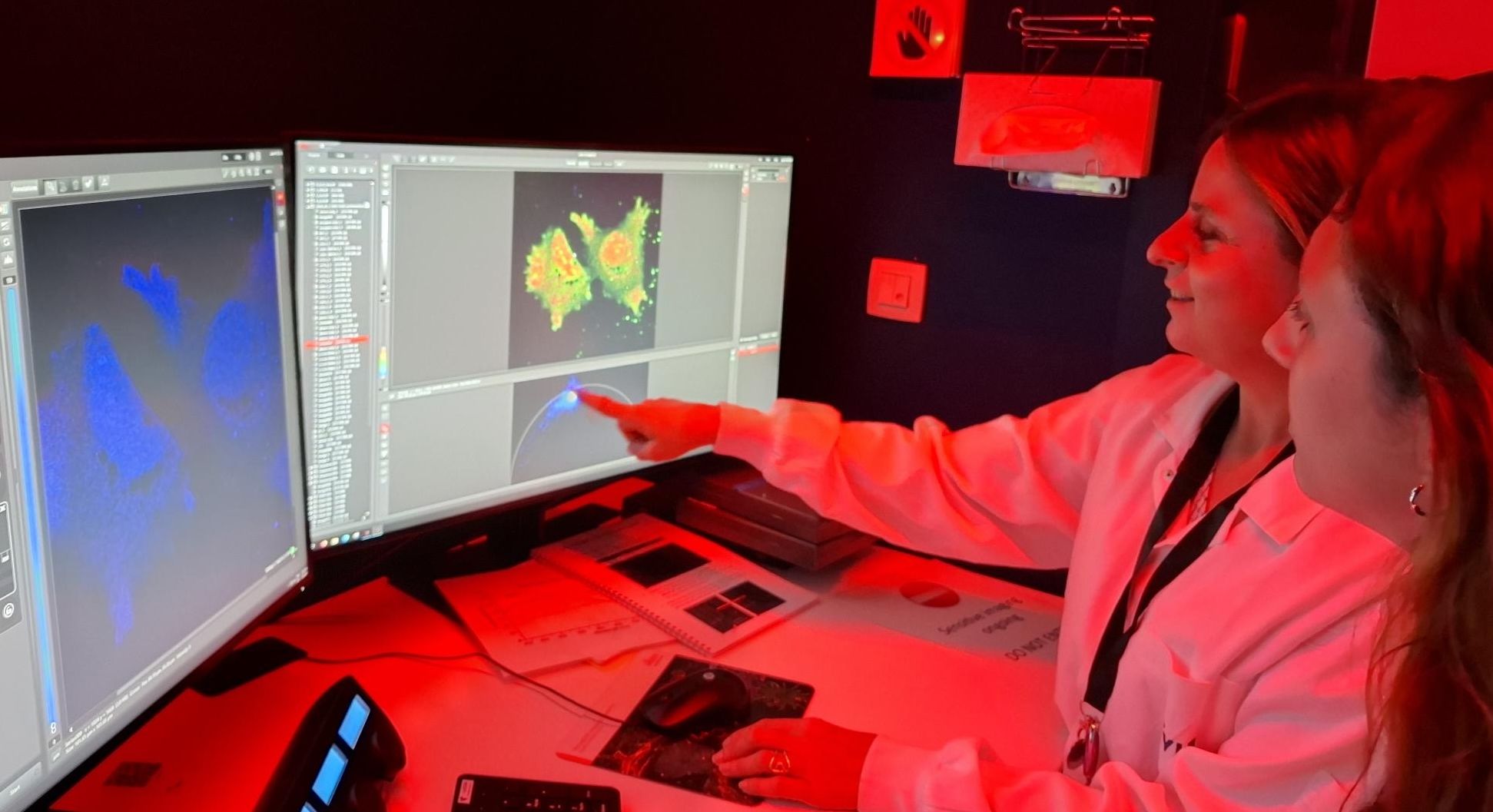
At the VIB BioImaging Core in Ghent, these measurements run on a Leica STELLARIS platform with FALCON lifetime detection, giving the team a reliable way to bring lifetime-based readouts into both method development and user projects.

FLIM-FRET: turning molecular proximity into a measurable shift
The moment FLIM becomes directly useful for interactions is when it is combined with Förster Resonance Energy Transfer (FRET). FRET occurs when a donor fluorophore and an acceptor fluorophore come within a few nanometers of each other, close enough to indicate molecular proximity consistent with binding or complex formation. If that happens, energy can transfer from donor to acceptor without emission of a photon.
“In a standard FRET experiment, intensity-based readouts can be confounded by uneven expression or labeling,” explains Eef. “FLIM offers a cleaner pathway: when energy transfer happens, the donor fluorophore has an additional way to lose energy, so its fluorescence lifetime becomes shorter. FLIM measures that shift pixel by pixel, producing a spatial map of donor lifetime across the sample.”
A consistent reduction relative to a donor-only control is strong evidence that FRET is occurring.
Monitoring interaction in realtime
In living cells, FLIM‑FRET is often implemented using genetically encoded fluorescent proteins fused to the proteins of interest. This enables dynamic experiments and time‑resolved interaction mapping, capturing molecular proximity, conformational changes, and biosensor responses as they unfold in real time.
Because the proteins remain in their native environment—unfixed, actively signaling, and embedded in the correct cellular context—the resulting lifetime shifts reflect true biological dynamics. Chemical fixation can alter protein structure, disrupt weak or transient interactions, change the refractive index, or introduce cross-linking that artificially forces molecules together. The fluorescent proteins themselves can behave differently after fixation, with shifts in lifetime, pH sensitivity, or photophysics that complicate interpretation. "Live‑cell FLIM‑FRET avoids all these pitfalls and preserves the physiological context: membrane composition, crowding, metabolic state, and signaling flux," explains Eef.
The trade‑off is that live‑cell imaging introduces its own challenges, like photobleaching, motion, expression variability, and the need to maintain your cells healthy under the microscope.
"But when the goal is to understand how interactions change, not just whether they occur, live‑cell FLIM‑FRET provides a uniquely direct window into functional biology as it happens."
Bringing quantitative interaction readouts into fixed tissue with QF Pro®
QF Pro® is a workflow designed to quantify interactions in fixed cells and tissue by combining two-site immunofluorescence with amplified FRET-FLIM. The idea is straightforward: preserve tissue architecture, label two proteins of interest, and use lifetime shifts to infer proximity in situ, even in autofluorescent tissue where conventional intensity-based approaches struggle.

Eef first encountered the approach through BioSPX (the life science division of BRS), via Wouter De Saedeleer, who represents the technology in Belgium and the Netherlands. The initial trigger was the broader rise of spatial biology workflows at VIB.
“People are mapping tissues with more and more labels,” Eef says. “And that naturally raises the next question: not only where are proteins, but where do they interact?"
HAWK Biosystems provided test kits, and the core recruited a handful of early users. Such early pilots don’t merely test performance, it;s also a way of gauging whether the workflow is compatible with real lab timelines and scientific incentives. “It’s never only about whether the method works,” Eef notes. “Equally important is if it fits the way people actually do research.”
The evaluation has since attracted the attention of the VIB Tech Watch Core, which recognized the potential for broader institute value. Eef connected with Bram Van den Bergh to explore how to move from an early, kit-driven pilot into a more scalable evaluation path. “It’s exactly the type of technology where it helps to have a broader view,” Eef says. “You can support multiple groups, and you can also be very clear about where the method is strong and where it isn’t.”
A concrete success story in a murine sepsis model
One of the most compelling outcomes so far is a user project that Eef presented as a poster at Focus on Microscopy in Stockholm in March. The biology is grounded in a murine peritoneal sepsis (CLP) model from the De Bosscher and Libert labs and focuses on interaction changes involving HNF4α, a regulator linked to metabolic gene programs in the liver. The experiment measured interaction signals in liver sections from healthy versus septic mice using QF Pro® amplified FRET-FLIM, including candidate interactors and appropriate controls.
When the same question was approached using standard immunofluorescence readouts, the interaction signal could not be resolved with confidence. When approached with QF Pro and FLIM-FRET, the lifetime-based readout revealed a measurable shift between conditions.
“That was the moment where it really clicked for people,” Eef says. “With regular immunofluorescence, you can show the proteins are there, but you can’t reliably quantify that they come together differently in diseased tissue. With the FLIM-based approach, you get a quantitative signal that actually reflects proximity. You see something you couldn’t see before.”
This is also where the BioImaging Core sees the methodological value. “QF Pro isn’t a generic replacement for conventional staining. It is a tool for a specific class of questions: those where spatial context matters, where proximity is the signal, and where intensity-based inference is too fragile to trust.” When it fits, it changes the type of biology you can validate in tissue.
Making functional imaging more approachable
The Ghent BioImaging Core team wants to use the QF Pro® case to make FLIM less “mystical” to the VIB research community.
“FLIM is not the easiest technique,” Eef says. “But once people understand what lifetime is and why it’s robust, they start recognizing where it can answer their questions.”
The timing is good. There is rising interest from additional groups who want to test interaction readouts in tissue, and VIB Tech Watch is exploring how to support a wider, more structured evaluation. There is also a natural connection to the institute’s broader shift toward integrated, spatial, multi-modal biology: as datasets become richer, researchers want methods that connect molecular measurements to mechanisms in context.
From the BioImaging Core perspective, the long-term value is clear. “A lot of researchers still don’t know that we can measure interactions in living cells and tissue in a quantitative way,” Eef says. “If we can make that visible, then we can help researchers turn a difficult question into a robust, quantitative assay, with the right controls and the right interpretation.”