.png)
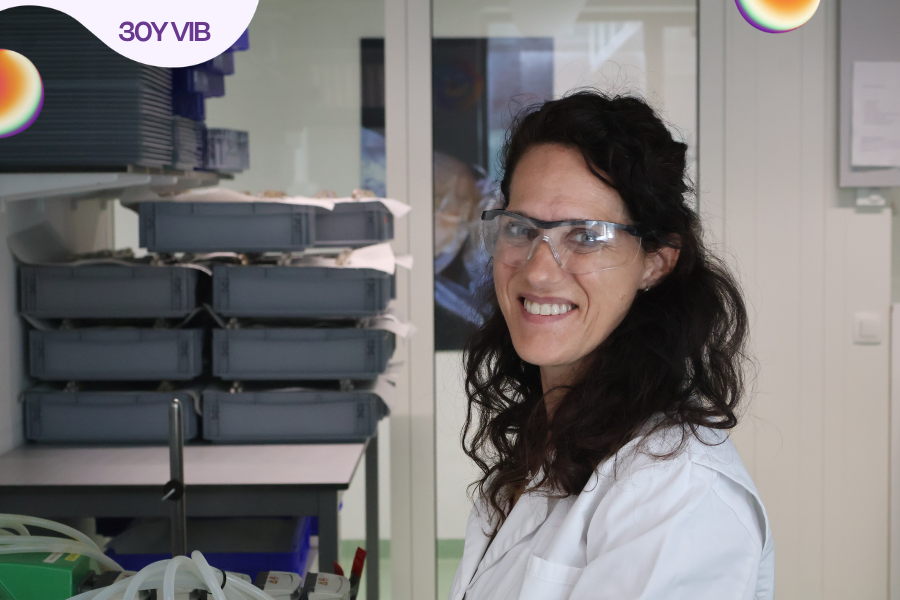
Supporting 30 years of neuroscience in Leuven: Meet Claudia Van Hove
For thirty years, Claudia Van Hove has been one of the quiet forces helping the VIB-KU Leuven Center for Neuroscience run smoothly. Claudia and the logistics team work behind the scenes to ensure everything is in place: from sterilizing materials and preparing fly food to maintaining facilities and helping colleagues across the centre. It is a job that spans countless tasks, and one that has kept her engaged ever since she first walked through the doors in February 1996.
Over three decades, Claudia has witnessed remarkable changes in the way science is done. She has seen research become increasingly technology-driven, watched generations of scientists build their careers, and helped support the day-to-day operations that make groundbreaking research possible. In this conversation, she reflects on the evolution of the centre, the people she has met along the way, and the teamwork that has made 30 years feel like the right place to stay.
Hi Claudia, could you introduce yourself and tell us what you do at the center?
My name is Claudia Van Hove, and I’ve been working here for 30 years. I’m responsible for different logistical aspects of the center: washing and sterilizing materials, preparing food for the flies, helping people, maintenance, and much more.
My job covers a very broad range of tasks, and that is actually what makes it so enjoyable.

Do you remember your first day at the center 30 years ago? What was it like? And how is it now?
I still remember it, yes. I started in February 1996. Everything was new to me — all these new products and materials that I didn’t know yet. My first reaction to a lot of it was: “Wow!”
Things were very different. There were many more experiments involving hazardous substances, including radioactivity. But now, technology has changed enormously. So much more is done with computers today, and there is much more advanced technology, microscopy and equipment.
And so, the practical side of research has changed too. When I started, we handled many substances ourselves. Products had to be weighed and prepared, and there were experiments involving materials that could be quite hazardous. Today, much more arrives already prepared. When I compare how we worked then with how we work now, the difference is enormous.
At the time, I thought I would just give the job a try. Thirty years later, I know that I wouldn’t want to leave anymore.
A lot of your work happens behind the scenes. What do researchers perhaps not always see about the work of the logistics team?
Our job is to make sure that everything is ready so that experiments can run properly. There are many logistical aspects behind that.
Whether it is preparing and sterilizing materials, making food for the flies, maintenance, or simply helping people with what they need, our work supports the different departments and helps keep everything running. That variety is one of the things I enjoy about my job.


You have also seen the careers of many researchers develop over those 30 years. What was that experience like?
I remember Bart De Strooper at an early age. He was very special to me, one of my favorites. At the time, of course, I had no idea that he would go on to become such an important figure, as it was quite strange to later see him becoming a director and seeing how his career developed. But he did a good job!
There were many other people as well, including Guido David and Fred Van Leuven. I remember people who were incredibly dedicated to their work.
Also, the center was already so international for me back then. I can say that really dedicated people, not just from Belgium, but from all parts of the world, have always been part of the center.
What has kept you here for so long? And how is the logistics’ team dynamic?
I still come to work with a lot of pleasure.
We have a really good team and, after working together for so long, we know each other very well. We can always tell each other what we think. It doesn’t have to become a conflict; we can simply be ourselves. I also thank Raymond Spans a lot for his work and companionship.
As a team, if we think something could be done better, we can just say it. Not everything needs to be discussed in a meeting or put into a formal framework. Sometimes you can simply talk to each other as people.
We can rely on each other, and that is really fantastic.
When you look back at these 30 years, particularly your work in logistics, what makes you most proud?
I’m proud that we make sure the work gets done and that things keep running properly.
Logistics may happen behind the scenes, but there is a lot involved in supporting the work of the center and making sure people have what they need.
When speaking to Claudia on her first day 30 years ago, again, I would hear her say “Let’s give it a try,” but I’d tell her, “You won’t even think about leaving anytime.” I know that for sure.
After 30 years, what would you like people to know about your experience at the Center?
That I still really enjoy coming to work.
And obviously, how I like my team. We know each other, we can be honest with each other, and we can rely on each other. We don’t need to make everything formal — we can talk to each other openly and simply be ourselves.
And after 30 years, I still come to work with pleasure. I think that says a lot about the working environment.
João Cardoso