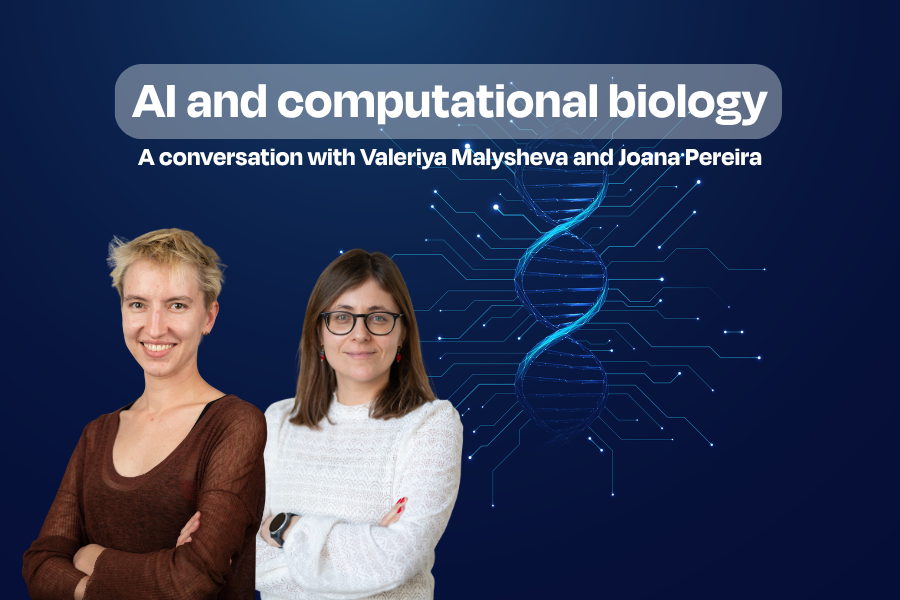
The next chapter: Integrating AI into the life sciences
From genomes to proteins, Valeriya Malysheva and Joana Pereira explore how AI is changing the questions we can ask about biology.
Artificial intelligence is rapidly becoming part of the way researchers investigate biological complexity, from gene regulation and cell fate to protein structure and evolution. In the run-up to VIB’s first AI and computational biology conference, taking place on 9–10 December 2026 in Leuven, we spoke with Joana Pereira (VIB.AI) and Valeriya Malysheva (VIB-UAntwerp Center for Molecular Neurology) about where computation and biology are converging, what AI can bring to biological discovery, and where the most exciting opportunities may lie.

Let's start with a little challenge. Can you summarize your research in a single sentence?
Valeriya: My team's research sits at the intersection of neuroscience, molecular biology, and AI, aiming to understand the regulatory logic underlying cellular decision-making at the molecular, cellular, and organ levels in health and dementia. Voila! Single long sentence :).
Joana: This is a difficult one, but I usually go with "I develop computational methods to understand what all proteins encoded by all genes in all organisms do".
The AI and computational biology conference focuses on a process that no field in the life sciences can ignore: the integration of artificial intelligence. As the last few years have shown, AI/machine learning moves really fast. How do you stay up to date?
Joana: It is not easy! Every week, if not every day, there is an interesting new paper introducing a method, a framework, a model, or a dataset, or just reporting an exciting biological discovery. As we work at the intersection of biology and computer science, we need to keep up with advances in both fields, which sometimes feels quite overwhelming. I try to stay informed by having alerts for papers that cite key authors in my field or that they publish, and by following the key journals on social media. We also have a "newsletter" channel in my group's Slack workplace, where everybody posts the cool, interesting papers they find. These function as a nice and rich source of papers for discussion in our weekly journal clubs.
Valeriya: Exactly, it is getting harder and harder to stay up to date and sift through all the exciting new studies released every day, which is why conferences like the one we're organizing are so crucial! Luckily, AI also offers solutions to keep up with its own rapid pace. A simple agentic AI workflow helps me catch key breakthroughs in both neuroscience and fundamental AI.
Which session(s) at the conference are you most looking forward to?
Valeriya: Genuinely, all of them! The program is stacked - not a single talk to be missed!
Joana: Agreed, I am very excited for the entire program; I think we have a very cool lineup of speakers. But if I have to choose, I would say session 2, on Genome to Function.

The genome is more complicated than many people seem to realize, and, Valeriya, one of your research strands is all about how it's organized. Gene activity is affected by epigenetic tags, enhancers that can be far away from the gene(s) they impact, and so on. DNA loops, winds around histones, condenses... In a way, this makes sense. It's a lot of DNA to pack and manage inside a small nucleus, after all. There's a lot happening at all times; how do you find what matters?
Valeriya: Great question! It's a major challenge across all fields of biology and cannot be addressed without building on the foundations of fundamental and applied causal theory, such as structural causal models and potential outcomes frameworks. However, it isn't just a matter of applying off-the-shelf causal tools, as biological systems introduce unique statistical challenges that make disentangling cause and correlation exceptionally difficult. This is why continuous experimental perturbations together with statistical and ML approaches must go hand in hand.
Joana, one of your research foci is mapping the entire protein universe. At the moment, roughly 10% of protein sequences have an accompanying accurate protein model. It's almost like a medieval map – here be dragons. Do you expect that there are entirely new classes of proteins (or protein functions) waiting to be discovered, or do you think it's more likely that we'll find infinite variations on known protein (function) classes?
Joana: It is hard to say, but I believe that in the structure space there are still some cool folds to be found. With the availability of the AlphaFold database, the ESM Metagenomic Atlas, and other follow-up projects, we have been highlighting some new predicted structural folds. Of course, these are predictions, and they need to be validated experimentally.
When it comes to function, that takes us to the definition of function per se. If we are thinking of chemical “activities”, I think we will not find new basic chemistry. What I believe is that we will find new variations and combinations of known molecular functions that will translate into new, or unknown, biological activities.
In both cases - the protein universe and the genome's complexity - geometry and topology are proving to be very important. Do you think this is given enough credit or is this an idea that needs more attention?
Valeriya: The 3D genomics community is extremely vibrant and advancing at an incredible pace, not just in academic research, but also in industry, with models like AlphaGenome explicitly modeling chromatin configuration. The 3D chromatin conformation continuously reveals surprising twists, especially at the single-cell level, challenging principles established at the bulk level, so lots still to be discovered! Where we probably need more attention is connecting these regulatory levels: bridging everything from 3D chromatin organization and gene expression all the way to the functional protein world and organ level.
With unlimited research funding, what would you do?
Joana: I would love to experimentally validate all our predictions and characterize the exciting new protein families we discover within a timeframe that lets these discoveries benefit society. Today, the speed at which we can make predictions using AI far exceeds the speed at which we can experimentally test them. This creates a major bottleneck in translating computational discoveries into biological knowledge. If I had unlimited funding, I would develop a high-throughput experimental framework to systematically characterize the vast unexplored regions of the protein universe at scale. Imagine going from discovering a completely unknown protein family to understanding its function in days rather than years. That would be a game changer!
Valeriya: I have several lab projects that would get a massive boost from unlimited funding! ;)
I think one of the major challenges in understanding the dementia landscape is severe data sparsity for less prevalent forms compared to Alzheimer's, such as Lewy-body dementia and Parkinson's disease dementia. We are putting a lot of effort into mapping this landscape, but causal inference with highly skewed and sparse data is tough. So, I'd definitely invest in generating comprehensive molecular and cellular datasets across the understudied dementias.
And finally, what’s a book you would recommend to everyone?
Joana: I think one that fits very well with the current times is “Light of Other Days” by Arthur C. Clarke and Stephen Baxter.
Valeriya: Science-wise, my favorites are The Book of Why by Judea Pearl and its meatier sibling, Causality. Absolute bangers! Otherwise, I'm very much enjoying the works of David Hume. Check out his “A Treatise of Human Nature", offering a very compelling alternative perspective on causality.
Thank you, both!
VIB's AI and computational biology conference will take place 9-10 December 2026 in Leuven, Belgium.
The conference brings together a diverse line-up of internationally recognized speakers who will showcase the latest developments and perspectives on the pivotal role of AI in studying the complexity of living systems - from untangling genomes and a system's view on cells, to unraveling disease process.


