Science can't promise certainty: What volcanoes teach us about trust
For the past four years, I have worked in science communication at the VIB-KU Leuven Center for Neuroscience, exploring how scientific knowledge can become more accessible, meaningful, and responsive to the communities it affects. This year, my experiences as a Science Trust Project Ambassador and at a volcano science communication summer school in Iceland have prompted me to reflect more deeply on what it means to build trust in research. But what can volcanoes teach us about communicating neuroscience?
By Bethan Burnside
Do you have a smoke detector in your home and change the batteries at least once a year? Do you always wear a seatbelt, even in the back seat? Do you exercise three times a week? Do you brush and floss daily? Have you practiced a fire escape plan at home? Last week, I read each question out loud to a room full of leading neuroscientists, psychiatrists, psychologists, and mental health researchers from across the globe. I had been invited to deliver a workshop on science communication, exploring how we can move beyond simply presenting facts to building trust and meaningful connections, as part of the Neuroscience Capacity Accelerator for Mental Health, organized by the International Brain Research Organization (IBRO) and Wellcome Trust.
With each question, sheepish laughter darted across the room. Then I asked everyone to count their "yes" answers. "Who got all seven?" I asked. No hands. "Six?" Nothing. "Five?" Still nothing. "Four?" Silence. At three, a few tentative hands finally appeared. At two, a few more joined. I paused and looked around the room. "And these," I said, "are some of the world's leading health and neuroscience experts!" The room erupted, the joke landing because everyone immediately recognized the contradiction: here was a room full of people who dedicate their lives to generating, interpreting, and communicating scientific evidence. Yet knowing what the evidence says had not guaranteed acting on it.
From Correction to Connection
In February 2026, I travelled to Washington, D.C., for the kick-off session of the Science Trust Project Ambassador Program hosted by the American Physical Society. First piloted in 2021, amid growing concerns about scientific misinformation, public trust, and political polarization during the COVID-19 pandemic, the initiative initially focused on understanding misinformation and equipping researchers to counter it. Over time, its approach evolved toward building more meaningful relationships between scientists and the public. We explored how conventional science communication has often relied on the information deficit model: the assumption that inaccurate beliefs or decisions contradicting scientific evidence stem primarily from a lack of knowledge, which can be remedied by providing more facts. Yet, as the Health & Safety Quiz demonstrated, even those who understand scientific evidence do not necessarily act upon it. Our values, lived experiences, identities, social relationships, practical constraints, and “science capital” all shape how we interpret and respond to information.
Recognizing these complexities lies at the heart of the Science Trust Project's guiding philosophy: moving from correction to connection. This shift reflects a broader evolution in science communication. Following growing public criticism of science in the 1960s and 1970s, the 1985 Bodmer Report, The Public Understanding of Science, promoted scientific literacy as a response. By the 1990s and early 2000s, however, attention had shifted towards dialogue, participation, and co-creation, challenging assumptions about whose knowledge counts and who should shape decisions. During the Science Trust Project, we explored this evolution through three models: transmission, centered on delivering information; interaction, emphasizing dialogue; and transaction, treating communication as a shared process of meaning-making and decision-making. Together, they suggest that successful science communication depends not simply on explaining science clearly, but on listening, valuing lived experience, and enabling meaningful participation.
Art, science, and trust
Anna Dumitriu’s residency at the VIB-KU Leuven Center for Neuroscience demonstrates how art-science collaborations can foster trust in science by creating space for dialogue, emotion, and critical reflection. Rather than simply communicating research more accessibly, such initiatives invite diverse perspectives and lived experiences into conversations about how scientific knowledge is produced, understood, and shared. Find out more here.
Campi Flegrei: When science cannot promise certainty
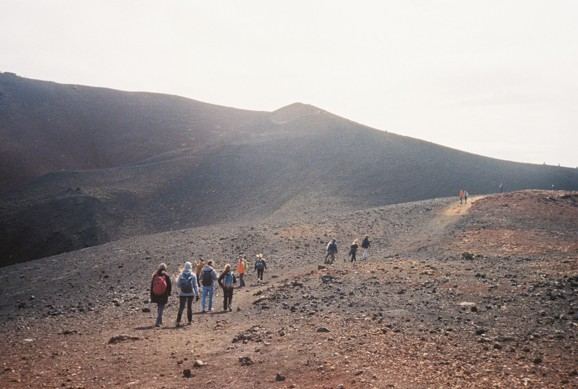
In June 2026, I travelled to Iceland for the University of Iceland’s Volcano Science Communication Summer School, which, for the first time in its nineteen editions, featured lectures from both volcanologists, including researchers studying Mount Etna, and science communication scholars from Vrije Universiteit Amsterdam. We were quickly introduced to the peculiarities of Icelandic life: the cold tap water cleaner than anything bottled, we were told; the sulphureous smell of the hot water was perfectly normal, apparently; and with roughly one swimming pool for every 3,000 inhabitants, a visit to the local geothermal pool was a must. Once the program began, however, I was reminded that I was a fish out of water, as the only professional science communicator in a room full of volcanologists. While everyone else pulled out their ubiquitous yellow geological field notebooks, I was still figuring out the difference between tephra and lava. Fortunately, the volcanologists had a sense of humor, particularly about Iceland's age: at around 25 million years old, the island is still considered something of an infant in geological terms.

We were introduced to the case study of Campi Flegrei, the vast volcanic caldera near Naples, which takes its name from the Italian for “burning fields”. Despite boasting one of the world's most sophisticated monitoring networks—which combines seismic, geochemical, and satellite data to detect even minute changes in activity—its interconnected system of hazards makes forecasting volcanic unrest extraordinarily difficult. Scientific observations must be verified and uncertainties assessed, while emergency services, policymakers, and residents cannot always afford to wait for certainty. Every warning carries consequences: false alarms can undermine confidence, while missed alarms can cost lives. Meanwhile, communicating too slowly risks leaving an information vacuum filled by speculation, sensationalism, and misinformation before scientists have had the opportunity to explain what is happening. This creates a difficult balancing act. Communicate too quickly, and preliminary findings may be mistaken for established conclusions. Communicate too slowly, and others may define the narrative before scientists have had an opportunity to explain what is happening.
These challenges brought me back to a key distinction from the Science Trust Project: trust versus trustworthiness. While trust involves choosing to rely on someone, trustworthiness concerns whether that confidence is justified. We explored this through the ABIO model of trustworthiness, which considers four key dimensions: Ability, Benevolence, Integrity, and Openness. For scientists, the problem is rarely a perceived lack of ability: according to a 2024 Pew Research Center survey, 89% of US residents consider research scientists intelligent, yet only 45% regard them as good communicators. Scientific expertise alone, then, is insufficient without clear communication, openness about uncertainty, and meaningful engagement. At Campi Flegrei, where residents may face life-altering decisions based on scientific assessments, trustworthiness depends not only on sophisticated monitoring but also on relationships built long before a crisis, particularly when volcanic unrest may persist for decades. Rather than asking, “How can we persuade people with facts?”, we might ask, “How can we become trustworthy partners in navigating uncertainty?”
Building trust in biotechnology
Through the Horizon Europe B-Trust project, VIB explores how trust in biotechnology can be fostered through early stakeholder engagement, active listening, and meaningful dialogue. Rather than simply seeking public acceptance of scientific innovation, the project emphasizes the importance of allowing diverse perspectives and concerns to shape its development from the outset. Find out more here.
Grindavík and Heimaey: Living with Volcanoes
Located on the Reykjanes Peninsula, Grindavík had long defined itself by the sea rather than the volcanoes beneath it. Settled during the Viking Age, it survived pirate raids and grew into a prosperous fishing town, experiencing no nearby eruptions for centuries. Even when earthquakes struck in 2021 and nearby Fagradalsfjall erupted for the first time in 6,000 years, excitement largely outweighed fear. Emerging from the COVID-19 pandemic, thousands of visitors flocked to the glowing lava fields, which seemed more a spectacle than a threat. By 2023, however, scientists detected magma accumulating directly beneath Grindavík, triggering extraordinary geological and social upheaval. During one intrusion, molten rock moved underground at a rate equivalent to several Olympic-sized swimming pools per second. Hot water supplies were disrupted, protective barriers were breached by eruptive fissures, and roads repeatedly rebuilt as lava reshaped the landscape. Engineers, one speaker joked, had become world experts in building roads on freshly cooled lava. As the ground shifted, so did residents' lives. Although government schemes helped many relocate, the emotional toll was profound. The once-vibrant fishing town became something closer to a ghost town, periodically reopening and closing as volcanic activity continued, its future uncertain.

Responding to Grindavík's rapidly changing conditions required close coordination between scientists, civil protection authorities, engineers, and local communities. Yet what stood out most from the stories shared with us was not catastrophe, but solidarity. Throughout the week, we repeatedly heard the Icelandic saying það reddast, loosely translated as “it will all work out.” In Grindavík, this seemed less like blind optimism than a pragmatic philosophy: accepting that the volcano cannot be controlled, but that its consequences must be managed collectively. A frequent point of comparison was Heimaey, the largest island in the Vestmannaeyjar archipelago. In January 1973, a volcanic fissure unexpectedly opened beside the town, burying or destroying roughly a third of the settlement beneath lava and ash. The eruption remains visible in Heimaey's landscape today, from streets ending abruptly at lava fields to the remains of a family home excavated beneath the ash, now preserved at Eldheimar museum. Its everyday belongings offer an intimate glimpse of lives interrupted by geological forces. The eruption increased the island's land area by roughly a fifth, while extraordinary efforts to pump seawater onto advancing lava helped protect its harbor. This collective ingenuity helped shape the island's recovery. While Grindavík's future remains uncertain, Heimaey demonstrates how cooperation and adaptation can create possibilities beyond the immediate devastation of a disaster.

Kairos: creating the conditions for connection
The experiences of Grindavík and Heimaey illustrate Iceland's culture of preparedness, where continuous monitoring, emergency exercises, and public briefings foster relationships between scientists, authorities, and communities long before a crisis. These relationships support decision-making during emergencies and collective learning afterwards, demonstrating that science communication is as much about sustaining trust as responding to disasters. The 1 April eruption, quickly dubbed the “April Fool’s eruption”, reinforced the limits of prediction when initial fears for critical infrastructure did not materialize. Yet preparedness requires more than sophisticated monitoring: it depends on transparency, community engagement, and responsiveness to people's concerns. But is dialogue alone enough? The Science Trust Project's progression from transmission to interaction and transaction emphasized shared meaning-making and participation. Yet inviting people into a conversation does not necessarily give them influence. Without meaningful power over decisions, participation risks becoming engagement-washing. Who determines which questions matter, and what happens when lived experiences challenge institutional priorities?
These questions take on a further dimension in a recent systematic review that challenges the foundations of the debate around the information deficit model. The authors found that the term encompasses such diverse assumptions about what publics lack, and what providing information is expected to achieve, that it is too imprecise to test empirically or apply consistently. Rather than abandoning information dissemination entirely, they propose an “empowerment model of informed publics,” which recognises people as active agents in scientific exchange. Rather than replacing dialogue and participation, this model shifts the question from whether to provide facts or foster dialogue to how to communicate science in ways that support informed decisions and meaningful engagement. This, however, raises a further question: how can people not only understand scientific knowledge, but also question it and influence decisions that affect their lives?
Building trust through belonging
VIB Leuven’s Inclusion & Diversity Committee demonstrates how trust within scientific institutions can grow through grassroots, relationship-centered initiatives. Through informal gatherings, shared decision-making, and inclusive practices, the committee fosters belonging and mutual understanding, recognizing that meaningful cultural change emerges through sustained relationships rather than simply transmitting information. Find out more here.
One concept introduced during the summer school helped bring these experiences together: kairos, an ancient Greek word meaning the right or opportune moment. In communication, it emphasizes the importance of timing and context, recognizing that even the right message may fail to resonate if the conditions for receiving it are absent. This reminded me of Monica Guzmán's I Never Thought of It That Way, which outlines five conditions for meaningful connection: time, attention, parity, embodiment, and containment. Do people have the time and attention to engage? Can they meet on relatively equal ground, despite differences in expertise? And is there space for disagreement, emotion, and lived experience within a conversation that feels safe and focused? Developing this kairotic ability requires sensitivity not only to scientific evidence, but also to context, relationships, and power. Rather than asking, “How can I persuade this audience?”, we might ask, “What conditions would allow this conversation to happen well?”

Across these experiences, from Washington and Munich to Iceland, the most significant shift in my thinking has been from what we communicate to how, when, and with whom. Volcanology and neuroscience may seem worlds apart, but both involve uncertainty, institutional authority, and decisions with profound consequences for people's lives. On our ferry ride back from Heimaey to the mainland, the clouds began to lift, revealing the snow-capped outline of Eyjafjallajökull, the glacier-covered volcano whose 2010 eruption disrupted air travel across Europe. The brief glimpse offered a different perspective on the landscape, a reminder of how much our view can depend on the conditions in which we encounter it. Scientific knowledge does not exist in isolation from the people who shape, engage with, and transmit it—including those whose lives are directly impacted by it. Correction can address misconceptions, but it cannot, on its own, build trust. That requires connection: taking people's experiences seriously, engaging with uncertainty, and communicating evidence with both rigor and humility.
Building trust through connection
The American Physical Society’s Science Trust Project equips scientists to build trust through reflective listening, empathy, and meaningful dialogue. Moving from correction to connection, its Ambassador Program trains scientists to foster more reciprocal relationships between science and society.
Interested in becoming an Ambassador? Applications for the 2027 cohort open at the end of October 2026!

Bethan Burnside