From alcohol-free beer to sustainable biofuels and chemicals: how the Verstrepen lab turns yeast science into impact
From brewing and bioethanol to future biomaterials, yeast expertise developed at VIB and KU Leuven shows how fundamental research, industrial partnerships, and a strong innovation ecosystem can translate science into real-world impact.
Can yeast be redesigned to produce beer with less alcohol while preserving flavor? Can it help produce more bioethanol from the same amount of sugar? Or even help turn waste streams into sustainable alternatives to petrochemicals and plastics?
These are not abstract questions. They reflect concrete challenges faced by industry today, challenges that increasingly require biological solutions. At the VIB-KU Leuven Center for Microbiology, the lab of Kevin Verstrepen has built a world-leading position in understanding and engineering yeast. What started as fundamental research has evolved into a platform that enables companies to tackle real-world problems in food, energy, and materials.
The lab has worked with major global industrial leaders such as AB InBev, LEAF by Lesaffre, Novonesis, and Barry Callebaut. Many collaborations started with a specific technical question and have grown into long-term partnerships. Along the way, the team developed a clear understanding of what makes academia-industry collaboration succeed.
Yeast as a solution platform
The Verstrepen lab studies how organisms, and yeast in particular, adapt to changing environments and stress through genetic change, epigenetic mechanisms, altered gene expression, and evolution. Its core model organism is Saccharomyces cerevisiae or baker’s yeast, the yeast species long used in baking, brewing, and winemaking. Around that core, the team combines evolutionary genomics, systems biology, and synthetic biology to understand how traits emerge and how yeast can be improved for industrial applications.
This scientific foundation has enabled the lab to develop a powerful yeast platform combining a highly characterized strain collection with comparative genomics, high-throughput screening, and fermentation expertise. More than a toolkit, it is a system that allows the team to identify and optimize strains for real industrial conditions.
“The core of our work is simple: we make better, superior yeast,” says Kevin Verstrepen, Director of the VIB-KU Leuven Center for Microbiology. “The unique combination of our yeast collection, screening capabilities, fermentation expertise, and forefront position in molecular biology allows us to develop strains that can address very different industrial challenges.”
Where basic science meets industrial reality
A defining feature of the Verstrepen lab is that fundamental and applied research are not treated as separate worlds. Around 50 researchers work across both domains, allowing knowledge, technologies, and questions to move continuously between discovery and application.
That balance has grown naturally over time. Some projects remain deeply fundamental, with long-term potential rather than immediate application. Others are highly applied and industry-driven. For Verstrepen, keeping the fundamental side strong is essential, even if it now requires more effort in a funding landscape where blue-sky research is under pressure.
The interaction between fundamental research and industry is central to the lab's approach.
“We learn a lot from our industrial collaborations because you get a much better view on the technological bottlenecks that are out there,” says Verstrepen. “That also gives us ideas for what to tackle in our more basic research.”
Jan Steensels, staff scientist and group leader for industrial research in the lab, sees this scientific depth as one of the main reasons companies come to them in the first place.
“Companies recognize the value of our basic research,” says Steensels. “They come to the lab because they see the quality of our work and expertise.”

A model built for collaboration
The lab’s scientific strength is only part of the story. What also matters is how collaborations are structured and delivered. The strongest collaborations are not technology-push exercises where academia tries to sell an idea, but demand-driven projects where a company brings a concrete challenge that requires the lab’s unique expertise.
“The collaborations that work best are the ones where the company approaches us with a question,” says Verstrepen. “If they have a very specific problem and we have the expertise to solve it, that’s when it works best.”
Even then, the lab is selective. Projects need to offer either a realistic path to implementation or a strong scientific learning opportunity. High-risk projects can be worthwhile, but only if the team can learn something meaningful from them. Otherwise, credibility depends on delivering.
“We’ve never taken projects where we thought we didn’t have a good chance of finishing them,” says Verstrepen. “Otherwise, you don’t get a second chance with the same company.”
According to Thijs Vackier, Business Development Manager at VIB, that reliability is one of the lab’s key differentiators.
“Companies work with us because they know what to expect,” says Vackier. “There is transparency, there is expertise, and there is a genuine commitment to finding a solution.”
That combination of scientific depth and reliability is what turns a first project into a second, and sometimes into a long-term strategic relationship.
Why partner engagement matters
The lab’s collaborations rely on more than scientific exchange. Companies need to provide enough information, materials, and process insights for the academic team to understand the real conditions in which a solution must work. Without that, even good science risks remaining confined to the lab.
“If the lab is expected to solve a real industrial problem, we need access to the actual industrial materials and process conditions involved. Otherwise, we’re stabbing in the dark,” explains Stijn Spaepen, Innovation Manager at KU Leuven.
Spaepen also points to another factor that can make or break implementation: internal alignment within the company. A project may be scientifically successful but still fail to reach application if not everyone in the organization is ready to adopt it.
“It’s important that the whole company is on board with the project,” says Spaepen. “Not only the head of R&D, but also, for example, the marketeers.”
This broader buy-in is particularly important in fields such as food and fermentation, where consumer perception can be as important as technical performance.
From brewing to bioethanol
The same yeast platform has created impact across several application areas.
In brewing, the lab’s long-standing collaboration with AB InBev has helped bring academic yeast science closer to industrial brewing practice. One recent showcase is the alcohol-free Tripel Karmeliet 0.4%, where yeast developed by the Verstrepen lab contributed to preserving the complexity of the beer while limiting alcohol production. Other projects have improved the quality, efficiency, and sustainability of beer production. The new yeasts bring real improvements, which explains why they are quickly implemented at truly massive scales. Today, more than 1 billion pints of beer are brewed every year with yeast developed by the Verstrepen team.

In industrial fermentation, the lab also works on bioethanol production. Here, the objective is to improve how yeast converts plant-derived sugars into ethanol. While the process itself is well established, even modest improvements in yield, robustness, or efficiency can have a significant impact at industrial scale.
“We’re engineering yeast to get more out of the same sugar, or to process more in less time and in smaller installations,” says Verstrepen.
This not only increases profitability, but at the same time also results in a more sustainable process that uses fewer natural resources and energy.
Progress in this field often comes through continuous optimization rather than one single breakthrough. Small improvements accumulate into gains in performance, cost-efficiency, and resource use. These developments remain relevant in a broader energy context, where bioethanol can contribute to sectors in which electrification is more difficult, including heavy transport and aviation. In fact, the global use of biofuels is rising steadily.
Beyond fermentation: towards biomaterials
The lab is also expanding into bio-based materials and circular production processes. This includes engineering yeast to produce building blocks for bioplastics and exploring how alternative raw materials, such as waste streams, can be converted into valuable outputs.
A particularly promising direction is the integration with chemistry, where catalytic processes convert plastic waste into substrates that yeast can use. This creates opportunities to reuse carbon that is already in circulation, contributing to more sustainable and circular production systems.
Looking ahead, the team also sees growing openness towards genetically engineered microbes and yeast, even in sectors such as food where such approaches have long been sensitive.
“Even food companies are getting more interested in genetically engineered microbes or yeasts,” says Verstrepen. “That’s a big paradigm shift that’s finally taking shape. It is exciting because it will result in both better products and more sustainable industries.”
The right support system
There is also a pragmatic side to how these collaborations are made possible. The lab works transparently, often at cost, with value created only when a successful result is implemented.
Funding mechanisms such as VLAIO and FWO are also critical. They allow companies and research teams to invest together in projects with clear application potential.
“Flanders has set up a really wonderful funding scheme to support bilateral research projects,” says Kevin Verstrepen. “Those, in our experience, have been the absolute most successful ones.”
At VIB, Innovation & Business support plays an equally important role. Legal templates, IP expertise, NDAs, project agreements, and financial frameworks lower the threshold for companies to engage and help collaborations move efficiently.
As Vackier puts it, this only works because both the business development side and the lab itself are aligned.
“It’s a joint effort,” says Vackier. “We can respond quickly to companies because the lab can make decisions quickly and communicate clear boundaries.”
The secret sauce: people, mindset, and delivery
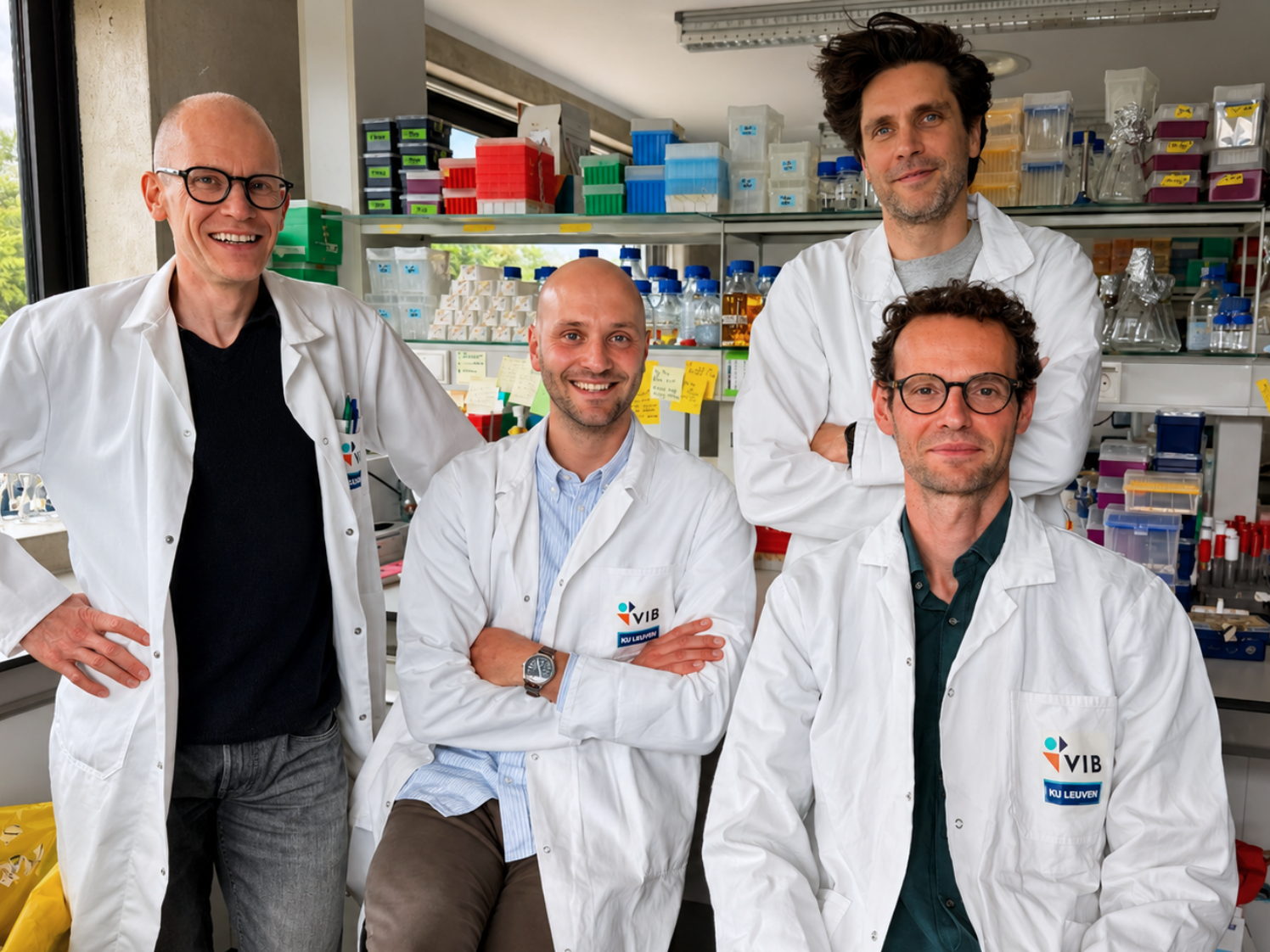
What defines the Verstrepen lab is not a single breakthrough, but a model: strong science, a clear technological focus and sustained collaboration, executed by a strong and experienced team of researchers that care deeply about where the work ends up.
Part of that success is structural. Long-term partnerships provide continuity and help retain senior expertise, which is crucial in an academic environment where industrial talent is in high demand. But part of it is also cultural: people are motivated when they see their work move towards real application.
For Verstrepen, this reflects a broader attitude to science and innovation.
“When faced with a problem, I want to look for alternatives and solutions,” says Verstrepen. “But our biggest asset is surely our team. The various researchers working on the industrial projects are true scientific heroes, highly skilled, motivated and simply a fantastic team of wonderful people that help each other and always go the extra mile, just because they care so much about what they are doing to help save our planet”.
In many ways, that philosophy captures the essence of the Verstrepen lab’s impact and of the broader VIB-KU Leuven innovation model: understand biology deeply, work with the right partners, and turn science into solutions that make a difference beyond the lab.