From Antwerp to Flanders as Nanopore Day keeps growing
What began as a local idea between colleagues has quickly grown into a meeting point for the wider long-read sequencing community in Flanders
Oxford Nanopore Technologies (ONT) has opened up new possibilities in genomics and transcriptomics. One of its best-known strengths is long-read sequencing: the ability to read much longer stretches of DNA or RNA in a single pass than conventional methods. That makes it especially useful for studying features that are difficult to capture with standard short-read approaches, such as repeat expansions, structural variation and other complex genomic regions, next to simultaneously detecting epigenetic signatures. As these applications continue to grow, so too has interest in ONT across many areas of research.
That growing interest will be on full display this Friday in Antwerp, where the second edition of Nanopore Day—now expanded into the first Flanders Nanopore Day—will bring together researchers from across a wide range of life science domains, including neuroscience, medical genetics, microbiology, plant biology, cellular biology and veterinary sciences.
How it started
The story started in Antwerp, where conversations between researchers and technology experts made clear that they had built up something special around ONT long reads. The Antwerp research community hosts several early and visible adopters of the platform, both in the use of nanopore sequencing itself and in the development of computational tools and analysis pipelines around long-read data.
“Within this community, the idea was raised to create a meeting where people could really show what they were doing with the platform and learn from each other,” explains Wim Cuypers, postdoctoral researcher at the Adrem Data Lab at the University of Antwerp.
That first idea grew out of discussions at a Biomina Lunch talk, where researchers like Wim & Bart Cuypers (Adrem Data Lab), Wouter De Coster (VIB-UAntwerp Center for Molecular Neurology, CMN) and Kris Laukens (Adrem Data Lab & Biomina, UAntwerp) realized there was enough shared interest, and more than enough local expertise, to bring the community together in a dedicated event. Rosa Rademakers, scientific director at CMN, immediately saw the value of the idea and supported the effort from the start.
Nanopore expert Mojca Strazisar, who heads the Neuromics Support Facility at the VIB-UAntwerp Center for Molecular Neurology, and Biomina Core Facility manager Eline Turcksin, were included and the core organizing committee was born.
Local expertise
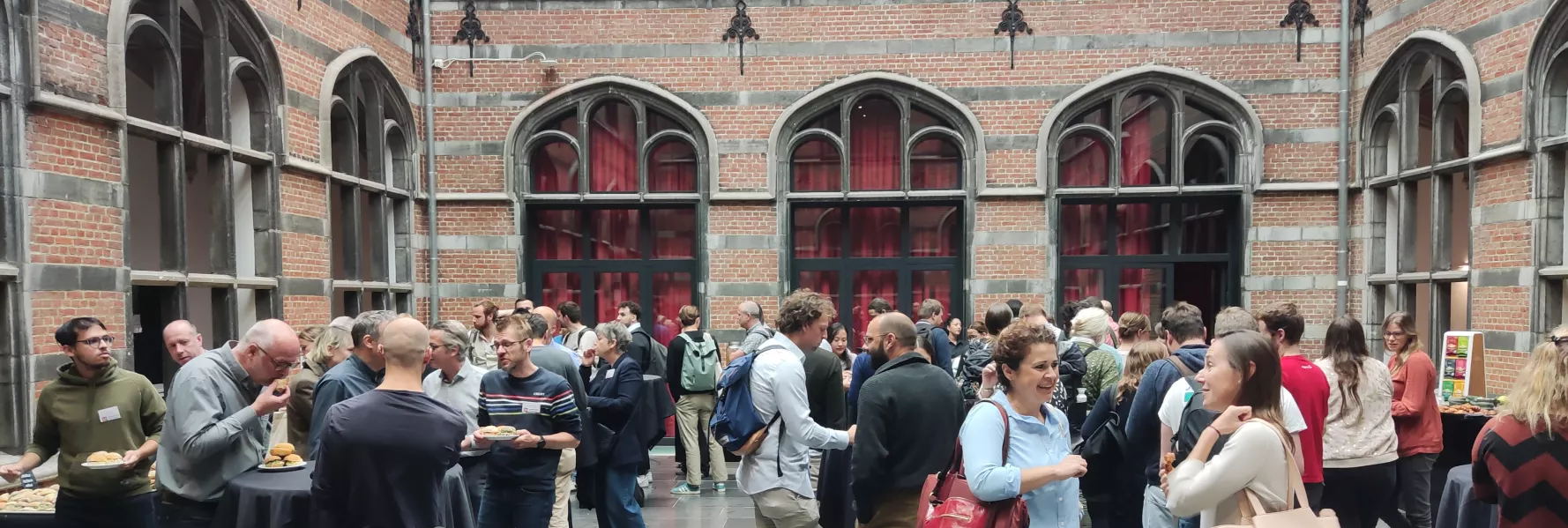
The first Nanopore Day was organised in 2024 with enthusiastic and generous backing from ONT. While initially budgeted for around 80 participants, the event filled up very quickly and was eventually expanded to accommodate more than 100 attendees.
“It was amazing to see all the different applications people were using long-read ONT sequencing for,” Mojca Strazisar recalls. “That was really the point of the first meeting: to get a sense of what different groups were doing, across very different domains.”


As head of the Neuromics Support Facility and Long-read sequencing expertise hub at CMN, Mojca has strong connections with most local users. The dedicated expertise available in her team is one of the reasons Antwerp has become such a strong hub for this kind of work. The ONT platform was adopted early through VIB Tech Watch, and from there, both the sequencing applications and the downstream bioinformatics support grew steadily.
Over the years, researchers at the VIB-UAntwerp Center for Molecular Neurology have invested heavily in developing wet-lab and computational approaches that apply long-read sequencing to questions in neurodegenerative disease research. UAntwerp colleagues at the Adrem Data Lab invested heavily in the development of data analysis pipelines and infrastructure for microbial long-read sequencing, in the context of adaptive sampling and pathogen monitoring research. Together, these complementary strengths have helped make Antwerp a visible and well-connected hub for ONT-based research.
Local researchers, such as meeting co-organizers Wouter De Coster (VIB-UAntwerp) and Wim Cuypers (Adrem Data Lab - UAntwerp) have helped shape the field internationally.
“Both of them have built a strong international reputation in long-read sequencing in their respective fields,” Mojca says. “They have been really instrumental to help us find the right speakers and build a scientifically strong programme.”

Reaching out across Flanders
Following the success of the first edition, the organisers realised the appetite extended far beyond Antwerp. For the 2026 edition, they expanded the scope to the whole of Flanders, bringing in additional partners from KU Leuven and Ghent University, and across the wider VIB network. The result is a much larger event, with more than 180 registrations, invited speakers, poster sessions, flash talks, and project prizes designed to make the day interactive and to give visibility to emerging work in the field.
Rather than generic sponsor slots, the organisers worked to ensure these contributions were tailored to the actual needs of long-read sequencing researchers.
“We really wanted the sponsor sessions to be useful,” Eline notes. “The idea was to bring in tools, applications and updates that genuinely help people working with nanopore long reads.”
What makes Flanders Nanopore Day particularly valuable is not only the programme itself, but also the community it is building. If this second edition is any indication, that community will only continue to expand.

From meeting to manuscript
Nanopore Day is not only about showcasing ongoing work, but also about creating new collaborations. A nice example already emerged from the 2024 Antwerp edition, where conversations during the meeting helped spark a joint project that later led to a publication in Molecular Nutrition & Food Research. In that study, researchers used ONT long-read sequencing to explore DNA methylation patterns in a cellular model of ageing.
A heartfelt thank you to all organizing partners and contributors who helped make the Flanders Research Day possible, including colleagues from VIB, UAntwerp, KU Leuven, and UGent. A full overview of the organizing team is listed on the Flanders Nanopore Day website.
Besides main sponsor Oxford Nanopore Technologies, and support from partners biomina (UAntwerp) and the Neuromics Support Facility (VIB-UAntwerp Center for Molecular Neurology), the Flanders Nanopore Day is enabled by Gold Sponsors Agilent, Avantor and Hologic Diagenode, Silver Sponsor Varvis, and Bronze Sponsor PathoSense.