.jpg "PID family day (@VIB-IneDehandschutter)")
Science beyond institutes: Citizen science at VIB
At VIB, we strive to translate our fundamental science into tangible benefits for society. One of the ways in which we do so, is by involving citizens.
More than measurement
First coined in the 1989 January issue of MIT Technology Review, citizen science has become a growing and important part of the scientific enterprise. While exact definitions differ, citizen science has an intuitive ring to it: to engage non-scientists in scientific research. Or, in the words of Scivil, the Flemish knowledge centre for Citizen Science, which has recently published its Citizen Science Scan 2025:
Citizen science is scientific research that is carried out in whole or in part by non-professional scientists (citizens), whether or not in collaboration with or under the guidance of professional scientists.
Notable in Scivil's comprehensive survey is the significant growth of scientific projects that include a citizen science aspect. Together, biodiversity and biology, and climate and environment account for close to 60% of newly started projects. The strongest increase in projects is seen in healthcare. That, too, makes intuitive sense. These research fields often benefit from more diverse data, both spatially and temporally (and, for healthcare, in terms of participants).
But, citizen science can be more than relying on citizens to collect data. More and more, non-scientists are involved in all stages of the projects, from inception to analysis.
Challenge accepted
At VIB, we strive to translate our fundamental science into tangible benefits for society. One of the ways in which we do so is by involving non-professional scientists (a beautiful term that reminds us you don't need a degree to participate in science).
Our Grand Challenges Program, for example, includes transdisciplinary projects where researchers from across universities and hospitals collaborate with citizens, farmers, and patients.
The Soy in Flanders project started by engaging more than 1,000 citizens to plant soybeans in their gardens. The goal? To find out which soil bacteria can help the crop grow in Flanders, and so support the protein transition toward more plant-based foods. Following up on this first phase, the project now collaborates with farmers who receive seeds coated with beneficial bacteria.
Without the enthusiasm of the 1,200 citizens and 50 farmers who participated in our soybean projects, this research could never have taken place on such a large scale. Our projects started with citizen science to collect Flemish soil bacteria and will also end with it, via validation in Belgian agricultural soils.
— Sofie Goormachtig (VIB-UGent Center for Plant Systems Biology)
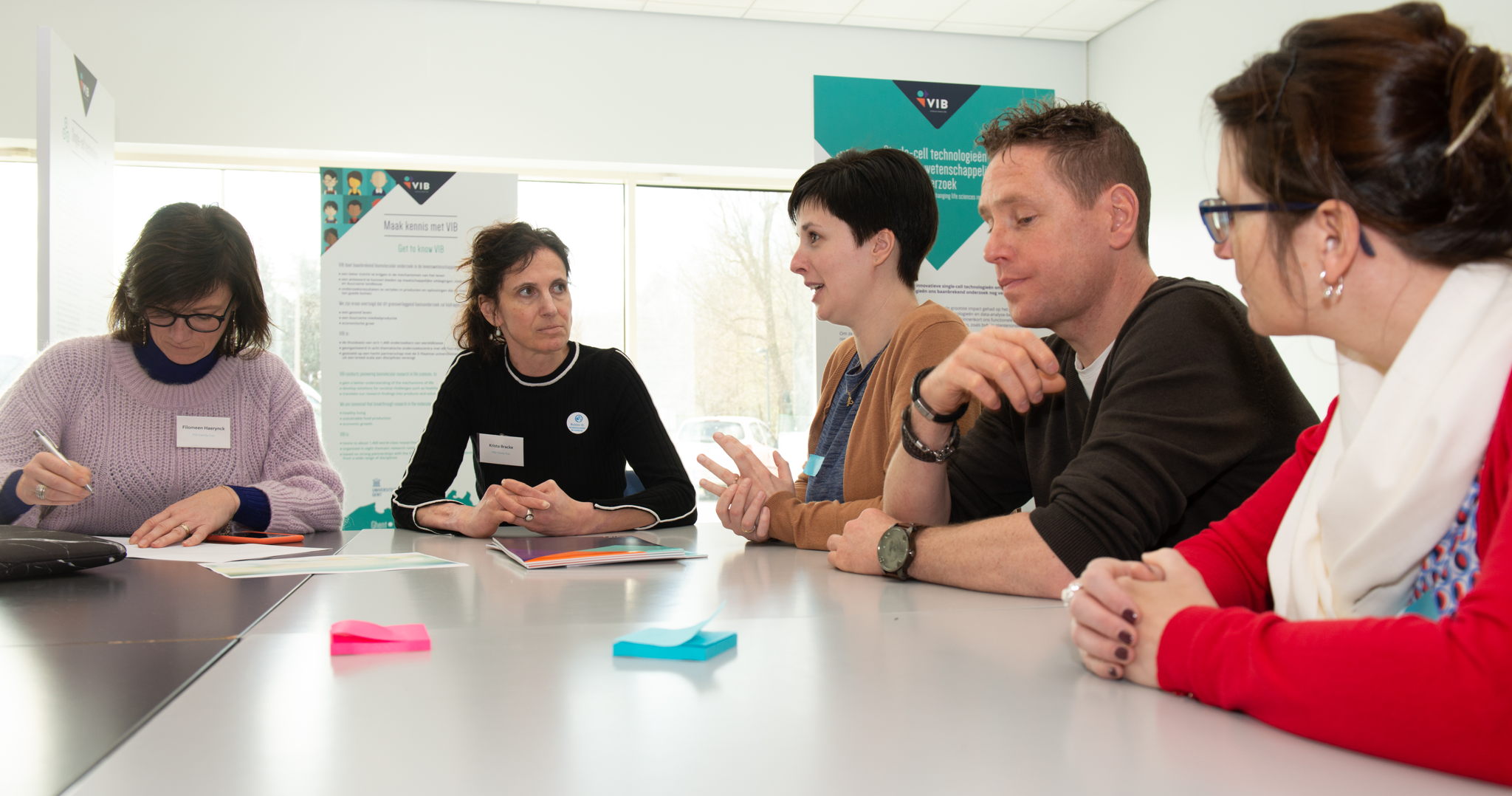
Primary Immunodeficiencies (PIDs) are life-threatening genetic disorders of the innate and adaptive immune system. The PID project, also in its second phase, is built on a close collaboration with a patient organization to develop a diagnostic test that will help clinicians make treatment decisions that will improve patients' lives.
Real progress in PID research goes beyond studies and clinical data, it’s shaped by the people who live with it every day. In our PID project, we work closely with the patient organization 'BubbleID', giving patients and their families an active role in our work. From initiatives like De Warmste Week to integrating patient feedback directly into the lab, this collaboration keeps our research grounded in real-world needs and driven by the voices that matter most.
— Tamara Jarayseh (UGent-UZGent), scientific project manager of the PID 2.0 project
.jpg)

Several more Grand Challenges projects have collaboration with non-professional scientists at their core.
- The COMPASS project wants to improve diagnosis for rare cancers called sarcomas. By profiling tumors with 'multi-omics', which combines data from multiple levels (DNA, RNA, proteins,...), this project will simplify diagnosis while enabling personalized treatment. To do so, the help and insights of patient organization Cum Cura is crucial.
- The Spartacus project also relies on working with patients to achieve drug-free remission of spondyloarthritis through early treatment with so-called 'biologics' (medications manufactured in or extracted from biological sources). The project also includes a health-economic model to assess the societal impact of this approach.
- Next up, to unite scattered efforts and build a true network of expertise on peripheral amyloidosis (a group of life-threatening diseases marked by protein accumulation), the BE.Amycon project works with patient organization Amybel to inform, connect, and support patients and their families.
- And what if we could treat Parkinson's disease with fecal microbiota transplants (FMTs)? The CUPIDGUT project aims to find out with the help of patients in a multicenter trial.
In all these projects, the inclusion and efforts of people beyond our institute and outside of academia are a crucial component of success, both scientific and societal.
Art and games
Sometimes, citizen science hides in unlikely places.
And it begins with inspiration.
Art is inspirational. It can even help us understand plant evolution and domestication. In the #ArtGenetics project, VIB scientist Ive De Smet and art historian David Vergauwen join forces with museum visitors to track the evolution of plants — crops, fruits, vegetables… — throughout history by studying their appearance in paintings.
By studying works of art, we are essentially looking back in time. Artists have created a visual archive of plant domestication. By analyzing these images today, we can gain new insights into how and when crops were shaped by humans.
— Ive De Smet (VIB-UGent Center for Plant Systems Biology)
Follow #ArtGenetics on Instagram!
Instead of museum visitors, scientists can also call on the help of millions of intrepid space explorers. In a game, that is. The mobile game EVE Echoes lets players explore a vast and complex universe with thousands of star systems. Along the way, they can solve puzzles. Those puzzles, the team of Lennart Martens figured out, could be a great way to analyze complex mass spectrometry data. So they teamed up with the developers of the game to work out a way to integrate their data into the game puzzles. The gamers' insights will then be used to train machine learning models that could improve diagnostics for a range of health conditions.
Learn more about the game here and download it in the App Store or Via Google Play.


Science is not confined to university labs or research institutes. At VIB, we believe and invest in science for everyone, by everyone.
Gunnar De Winter