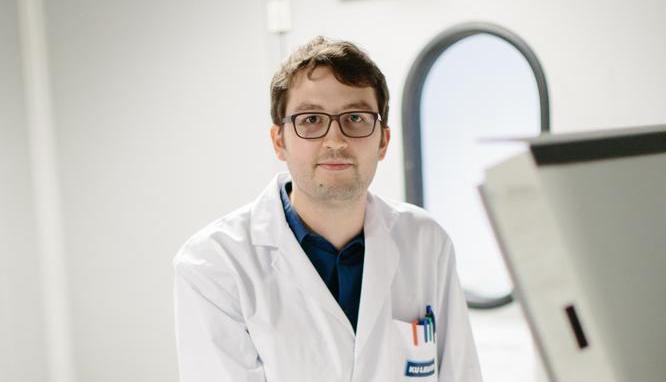
.jpg "Bram Van den Bergh, VIB Tech Watch team")
“Startups are often surprised by what we do”
Bram Van den Bergh on the unique value the Tech Watch Core brings when scouting, testing, and smoothing the path for breakthrough tools
“As a PhD student, whenever I could play around with new tech for my experiments, I was happy,” says Bram Van den Bergh, technology expert at VIB’s Tech Watch Core. His tech curiosity is now an integral part of the job: Tech Watch spots new scientific instruments and methods and de-risks the ones that are most interesting for VIB researchers. Bram and his colleagues technically evaluate the promises made by companies and test the limits of new platforms with real samples from scientists across all of VIB’s centers. If the technology delivers, they help shepherd it into the hands of labs and core facilities at VIB.
While most core facilities focus on a dedicated technology, Tech Watch does the opposite. “We don’t provide service in one specific technology area,” Bram says. “We scout, evaluate, and de-risk innovative technologies across the board. We work more upstream, long before a technology becomes part of our service portfolio.”
When he explains this to startups, their response is often disbelief. “Startups often don’t know what they’re hearing,” he laughs. “They’re startled, in a good way, that a research institute has a dedicated group to find them early, give structured feedback, and coordinate testing across so many biological domains. In many cases, this is of huge value to them and therefore they are keen to collaborate with us.”
Scouting and landscaping
Research groups turn over constantly: new PhD students arrive, postdocs stay a few years, and then move on. “It would be a shame if people didn’t know what we do and couldn’t benefit,” Bram notes. That visibility may be more straightforward for a BioImaging Core or Flow Core, for example, as the name says exactly what you get. The concept of Tech Watch sometimes needs a bit more context.
“From the outside, the words ‘Tech Watch’ could mean almost anything,” he admits. “Our mission is to ensure VIB scientists have early access to the most innovative technologies, things that were impossible before, or that offer a significant leap. An incremental update on a microscope? That’s not us. But an innovative new platform technology? That’s where we jump in, if it’s useful to the VIB researcher community of course.”
The scope can be quite broad, he says: “It could be a startup that levitates cells to sort them in a novel way, or chip-based sensors to ‘electrically image’ biology. Another recent example is flexible caging technology offering single-cell functionalization coupled to RNAseq.
Two big parts define the preparational work: scouting and landscaping. Scouting is the hunt: patents, preprints, conference halls, industry whispers. Landscaping is the context. “If you find a new spatial proteomics platform, you can’t evaluate it in a vacuum,” Bram says. “What else exists? How do specs compare? Which partner is the better fit for our researchers? That’s the analysis I’m knee-deep in right now.”
Sometimes the order flips, when a specific and tangible question comes in. For example, when a group leader wants to buy an instrument and asks Tech Watch to benchmark alternatives. “We don’t do that for commodity gear like pipettes,” Bram says. “But for frontier tools, yes. Especially if they’re complex, and still at an early stage.”

Bram Van den Bergh, Andries De Koker, Wai Long Tam, Samantha Zaunz, Sarah Geurs, Toon Swings
Reality check
After scouting an innovation with promising relevance, the next step is to involve people who will eventually run or use the tech.
“Because we’re embedded in VIB Technologies, we can immediately loop in the right Cores,” Bram explains. “If it’s spatial proteomics, we collaborate with the Spatial Catalyst and the Proteomics Core from the start. Do they see value or key attention points? Would they test it, and, if positive, how would they fit it into their portfolio? Tech Watch’s role isn’t to buy hardware or software, but to assess and lower risk, compress timelines, and align incentives.”
That alignment includes negotiation and logistics. Early-stage hardware may be on the other side of the world; we have to get it to Flanders, secure space, set environmental monitors, plan safety and data paths.
It’s also important to make sure the company only promises what its prototype can deliver, says Bram. “Expectations on both sides of the table need to be managed, and the best way to do that is to be open and transparent up front. If a press release lands too early, our inbox fills with ‘Can we test it next week?’ Meanwhile, the device might be delayed, or simply not ready for our test cases. We’ve learned to pace communications so expectations match reality.”
When it comes to testing and costs, Tech Watch also has a transparent policy.
“We aim to reduce the risks for every VIB lab,” Bram says. “The companies we work with provide their platform mostly for free, and Tech Watch has some resources to facilitate access. In return, our value to companies is structured access to a broad user base and honest, domain-specific feedback, including suggestions for improvements for a next version. That’s the deal. And in our experience, most startups value our collaboration and view it as a pretty good deal.”
Clearly, VIB researchers get a pretty good deal as well, though Bram stresses the financial incentive isn’t and shouldn’t be the main driver. “Yes, expensive machinery or consumables are a thrill to work with, but the real thrill should come from working with an early prototype. A piece of technology that is unique in the world, allowing you to run an experiment that was impossible before. I know that for myself and my colleagues, this what makes our hearts beat faster.”


"We negotiate from the strength of representing a whole institute."
- Bram Van den Bergh
A regular day at Tech Watch
That’s simple: there isn’t one. “Some days it’s all screening,” Bram smiles. “Reading patents, mapping competitor landscapes, jumping from an intake call with a startup in Taipei to a debrief with a core facility.” The next day might be hands-on: “Wheeling in a prototype, checking power, temperature loggers, network access. Do we have the right shakers? Is single-cell sequencing available downstream if this workflow needs it?” Other days, the team is knee-deep in experiments, doing hands-on lab work with the latest technology. The team of six keeps small, fully equipped Tech Watch labs in Leuven and Ghent precisely for this early, neutral testing.
The testing itself generally starts simple. “Usually, we begin with technical feasibility, not biological novelty,” Bram says. “If a platform claims subcellular capture, we aim to isolate easy and large subcellular structures that are well known and verify whether they have the right proteome. It may sound boring, but it tells you the fundamentals. Only once that part is solid do we invite researchers to bring real, meaningful samples that push the limits of the device. As a surplus, that may deliver some biologically relevant results for the researchers engaged.”
If the use case is niche, Tech Watch may arrange for a PI’s group to lead the evaluation. If it’s broadly applicable (or the potential impact is big), the team keeps it in their own labs longer, to shoulder the risk and workload. “We do this week in, week out,” Bram says. “A single lab can’t provide that breadth of testing while pushing their own experiments forward. We can. And we negotiate from the strength of representing a whole institute.”
Why startups are surprised, in a good way
Many early-stage companies are founded by brilliant engineers or scientists. “They’ve built an impressive device or workflow,” Bram says, “but biology is messy. Sample types vary. Downstream analysis matters. We provide that biological context and a feedback cadence: what works, what fails, what features are missing, what references or white-paper data would we need for VIB to engage in the technology?”
Companies are dying to get clear answers to those questions. The best argument for the added value offered is that more and more, new startups reach out to Tech Watch themselves.
Sometimes, the technology is so specific and innovative that even its developers don’t have a full picture of potential use cases. This provides yet another way for the Tech Watch Core to add value, says Bram. “We often guide founders through the needs of the research community. What’s in it for us, is that we can steer startups to our own needs. On more than one occasion, a company created a dedicated track within their tech developments to meet the needs of our researchers.”
Sometimes Tech Watch will run head-to-head comparisons across multiple vendors in the same domain. Protein sequencing is a good example. “It’s a booming field with few mature devices yet. We’ve identified around ten companies, each with a distinct platform and features that could be decisive depending on the application. We don’t put all our eggs in one basket, though. We keep several options in play and are actively negotiating or lining up tests with multiple teams.”
If a platform shines, Tech Watch helps move it along the pipeline, often into a core facility or a research group that wants to adopt it. “We don’t fund purchases,” Bram clarifies. “But we do negotiate. If we generated strong data, presented at conferences, wrote a white paper, and co-organized seminars, companies tend to meet us in the middle.”
Guardrails on the hype
External communication can be a minefield. “Companies are eager to say they’re working with VIB,” Bram acknowledges. “Of course, we want them to succeed, but premature announcements create pressure and high expectations. If delivery slips or performance isn’t there yet, everyone loses.”
Even with those guardrails, Tech Watch does sometimes help with investor diligence—when the startup asks. “If a company is raising funds and their investors want to talk to real users, we’re happy to share our experience,” Bram says. “But we’re honest. Our job is to evaluate, not to market.”
To avoid any conflict of interest, the team only interacts with investors upon request of the company." We know that startups and technologies may take a while to develop, mature, and get to a state that is commercially viable. We wouldn’t want our evaluations at very early stages to derail investments, killing a promising platform prematurely.”


"Tech Watch’s role is to push the boulder over the hill, and then get out of the way once that boulder starts rolling.”
- Bram Van den Bergh
A timeline in practice: from first email to first data
The recent Syncell story captures the long arc well. This startup developed a complex workflow coupling spatial protein tagging and enrichment during purification with high-sensitivity mass spectrometry for discovery and identification. Years before any device arrived, the Tech Watch team shipped early test samples to exercise a nascent workflow. “Back then, there were no instruments outside the company,” he recalls. “As the platform matured, we arranged for a demo device to be installed in the Leuven Tech Watch lab in exchange for structured feedback. That’s the order: early remote feasibility, then on-site evaluation, then (if it proves itself) wider access.”
Not every technology makes it through. “Sometimes the science is fine, but it isn’t a fit for our programs, or the interest isn’t there,” Bram says. “That’s okay. Our job is to learn fast and reduce risk for everyone.”
When it does click, the hand-off is smooth. “If a core is interested, they take the lead on service and training. If a lab wants to own it, we stay in the background. Tech Watch’s role is to push the boulder over the hill, and then get out of the way once that boulder starts rolling.”
Just in time
It comes back to a simple belief shared across VIB: technology catalyzes discovery. “Great biology starts with great questions,” Bram says, “but not every question can be answered with a centrifuge and a pipette. Sometimes you need a new capability. True single-cell physiology, unbiased subcellular proteomics, novel cell sorting paradigms… Our job is to make sure those capabilities appear just in time for the people who need them.”
According to Bram, the fact that this job entails such a wide variety of tasks is exactly what makes it fun. “I love the satisfying thud of a flight crate opening on the lab floor. Those are the best days,” he says. “You really see the future arrive before your eyes.”