Building bridges from science to society
Called to Science with Jiska van der Reest
VIB’s podcast Called to Science is back for a second season! In this series, we sit down with researchers to go beyond the research to explore the passion, setbacks, and big questions that drive them forward.
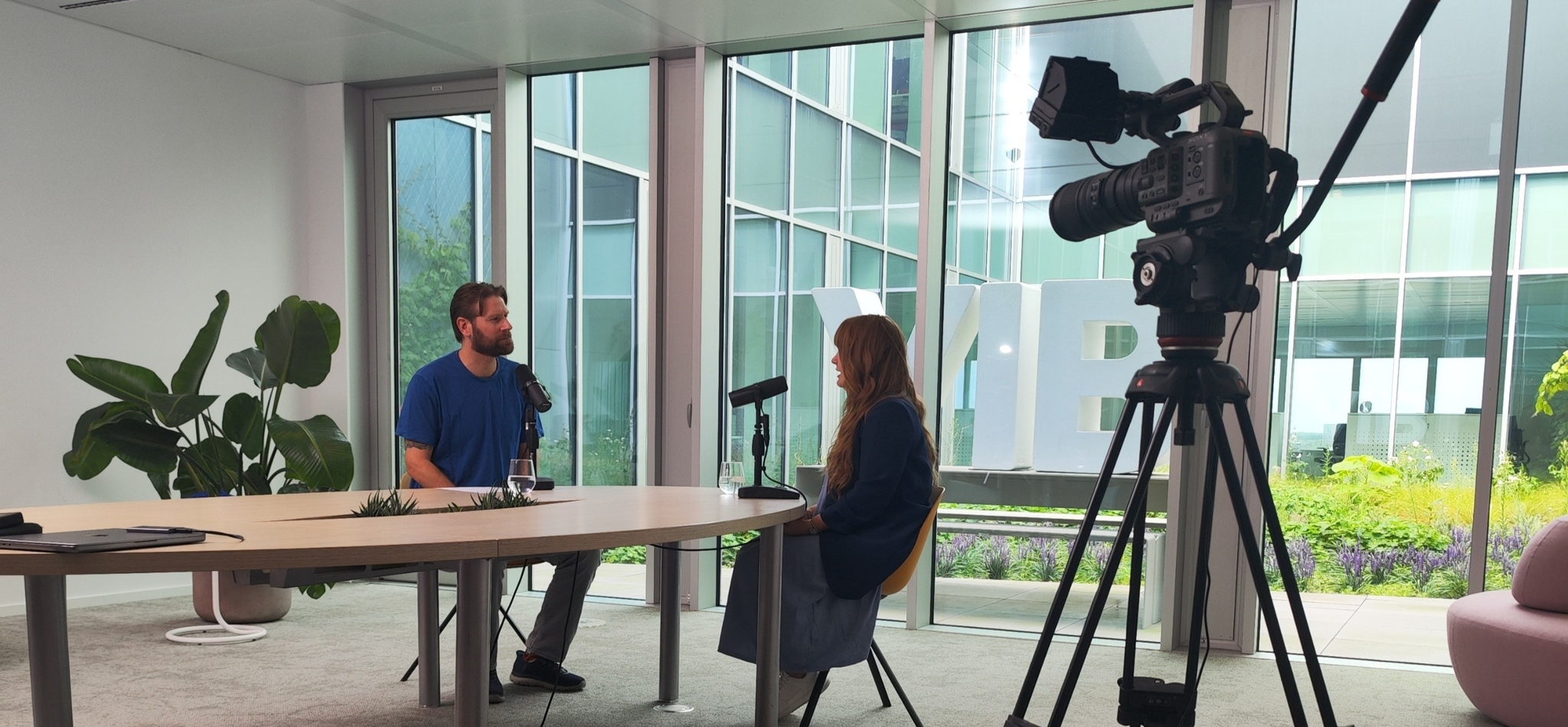
In one episode, science journalist Brad Van Paridon speaks with Jiska van der Reest, Business Development Manager at VIB Headquarters. Their conversation dives deep into the worlds of business development and social innovation. Here are some highlights from the discussion.
Curious about the other guests? Check out the full series on Spotify, Apple Podcasts, YouTube, or wherever you get your podcasts.
Hi Jiska, you've had this, let's say, unconventional path from the lab to the world of business. You studied cancer metabolism in your PhD, but when were you introduced to the business side?
Jiska: “I think I never was particularly interested in business. I think the last business class that I took was maybe in my early bachelor's, so I did not foresee this path at all. But I was always active in all sorts of other things when studying and doing my PhD. I was active in student advocacy organizations, I did things with the United Nations, participated in summer schools, and joined courses on biotech. I did literally everything just to figure out whether I liked doing it. For some things, I realized, this is not really for me. But I do think your PhD is a time when you need to explore and not just focus on your lab work. You will never have access to these opportunities again.
I also think all these bits and pieces I picked up along the way allow me to do the job I do now, because you need a breadth of expertise to be successful in the business world. I would say people should just really explore and make use of figuring out what it is exactly that you like to do, because before you try it, you don't really know.”

Hearing you speak about these different opportunities that you jumped on that you were presented, but also hinting at your motivation there. I'm curious, then, how does that end up in the business world and not, say, politics or the non-profit world?
Jiska: “I actually started out in more of the non-profit social innovation sphere. A lot of these programs are focused on social innovation. They bring together scientists and people of all disciplines. They give you a set of problems that exist in the world. Then we try to put our expertise together to come to solutions.
Many NGO-type solutions are not self-sustaining because, in the end, they rely on money coming in to create something. In contrast, social innovation tries to create businesses that can build a business model to solve such a problem, so that it actually sustains itself, because that is essentially what's going to help the community. Charity work is also important; it has a role, but it would be better if it were self-sustainable because then it can go on and on.
That's when I started focusing on entrepreneurship and business. But I feel like it's very similar here at VIB because we are a non-profit organization. We have a mission of creating social impact for patients, for society, for the planet. We're trying to turn that science into these solutions, but we do need a business and financial aspect to it. Otherwise, again, that's not going to be self-sustainable.”
What does your day-to-day role as a business developer look like?
Jiska: “That's actually something we ask ourselves in our team all the time because it seems to be everything, and it's not really a clear job description. But essentially, what our goal is, is that we basically scout among the research that's happening at VIB for the things that could really spark something, whether that's drug development or diagnostics, that can sustain certain processes there is a need for.
Then we go and look for what the standard of care is today. Could this be better? Who would be helped with that or with certain technologies? Is there a market gap? Do companies with problems they can't solve use one of our technologies, and would they be willing to co-develop it further with us?
It's a lot of development of the internal project. The science, of course, is primarily fundamental at VIB. There's quite a road still to go towards it being application-ready. That's what we do with the other innovation and business colleagues, that we look at what the technical improvements are, what risks are embedded in the technology that we need to mitigate, what are the scale-up steps, how can we expand maybe the validation package to prove that this works in different contexts.”
To hear the full conversation with Jiska van der Reest, listen to the complete episode of Called to Science on your favorite podcast platform.
About the podcast
Called to Science is produced by VIB. Each episode features candid conversations with scientists and innovators, exploring the personal stories behind scientific careers and discoveries. Check out the full series on Spotify, Apple Podcasts, YouTube, or wherever you get your podcasts.