Called to Science with Elina Kuznecova
VIB’s podcast Called to Science is back for a second season! In this series, we sit down with researchers to go beyond the research to explore the passion, setbacks, and big questions that drive them forward.
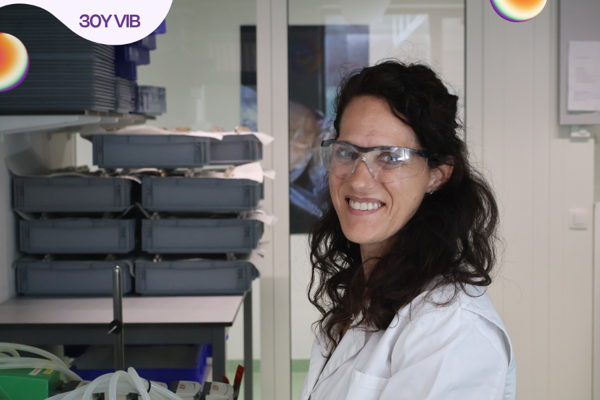
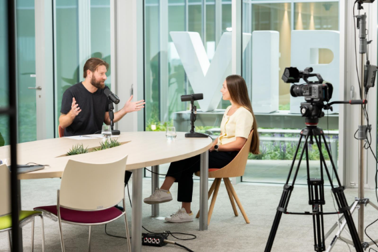
In one of the season two episodes, science journalist Brad Van Paridon speaks with Elina Kuznecova, research technician at the VIB Spatial Catalyst, part of VIB Technologies. Their conversation touches on career choices in science, dealing with failure, and what it means to work at the interface of emerging technologies and research support. Here are some highlights.
Curious about the other guests? Check out the full series on Spotify, Apple Podcasts, YouTube, or wherever you get your podcasts.
Hi Elina, so you’ve moved from Latvia to the UK for your education and ended up doing your master’s degree in Biomedical Research there. You then had to choose whether to pursue a PhD or go to industry. Was this a hard decision?
Elina: “I’ve had this struggle of whether to pursue a PhD or not for a couple of years. At the moment, I feel my career can progress without a PhD. I'm not saying that I'll never do a PhD, but maybe not now. I did consider moving to industry, because this was a logical next step. It's a funny thing, because I was offered two positions after my previous job, one at VIB, my current position, and another in industry, exactly what I was looking for as my next career step. Something didn't feel right for me, however, and I felt like I would miss the research environment. I just followed my gut. But indeed, people sometimes overlook the opportunities beyond the typical PhD. For many exciting careers, you don't necessarily need a PhD to proceed and to grow.”

So, you followed your gut feeling to come to VIB as a research technician. What excited you about this opportunity?
Elina: “I must say that the most important factor that affected my decision was the team. When I met them, we had such good chemistry, and I really felt like together we could do a lot. I met a lot of passionate people, and I knew that this was the team where I would love to work. My team lead is incredibly passionate. And, of course, there is the technology. I had never heard about spatial biology before. It was mind-blowing. These are the main things that affected my decision, I would say. Then I started to learn about VIB and how great it is to work at VIB and that it's one of the most influential research institutes in all of Europe.”
The position you have now, as a technician in the Spatial Catalyst, what does it involve?
Elina: “Yeah, not a lot of people actually know what spatial biology is. It is really a fresh field, I would say. Traditional molecular biology methods look into whether there are genes expressed or proteins expressed in tissues. But spatial biology also has a context of location, so it’s also about where exactly these genes and proteins are expressed in the tissue. If we imagine a city, traditional biology methods will let us know whether there are hospitals, schools, or shops in the city. But spatial biology methods will actually allow us to know where they are in the city and how far they are from each other, how they interact.
This is particularly important in fields such as cancer research, because tumors are not homogeneous. There are different layers in the tumor, and it's really important to understand where exactly in the tumor the genes are expressed. This will allow us to develop more targeted therapeutics as well. But it's not only for cancer research; this is applicable to a lot of fields.”
You’re somewhat of a social media celebrity, actually! You’ve made your research journey public to almost 100.000 people under the handle elina_in_science on Instagram. What motivated you to start this account?
Elina: “When I started my English-speaking account, I was really excited about the research that I was doing at that time in Oxford, which I wanted to share. Another thing was that, during my master's degree, I started facing a lot of isolation due to failure. There is a lot of failure in research, and everybody knows that. But when you are not as experienced, you take it very personally sometimes. I didn't feel like I had a support community to talk about this. I found a couple of Instagram accounts where people were actually sharing that, "Yeah, I failed today," or "I made a horrible mistake today, but life continues." But you still do the research. I also wanted to create such a community for others, to support researchers, bachelor students, master students, and to let them know that we're all in the same boat. Things happen. And at the same time, to support their understanding of basic techniques.”
To hear the full conversation with Elina Kuznecova, including her reflections on spatial biology, scientific careers beyond a PhD, and science communication, listen to the complete episode of Called to Science on your favorite podcast platform.
About the podcast
Called to Science is produced by VIB. Each episode features candid conversations with scientists and innovators, exploring the personal stories behind scientific careers and discoveries. Check out the full series on Spotify, Apple Podcasts, YouTube, or wherever you get your podcasts.