Modern science needs stronger infrastructure, and a new generation is rising to build it
Behind every cutting-edge experiment is a growing need for people who can build, manage, and future-proof the infrastructure that makes science possible. With its first ARISE fellow from EMBL, VIB is joining a European effort to train exactly that new generation of research technology professionals.
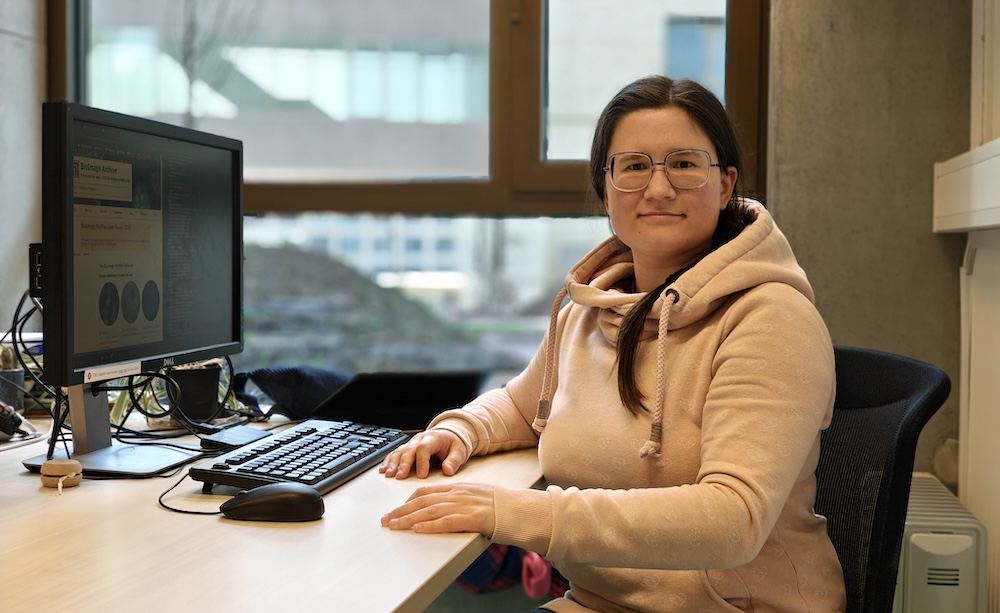
VIB is hosting its first fellow from EMBL's ARISE programme, a European initiative that trains scientists to build and run research infrastructure. Alexandra Zakieva, a data manager, joined VIB's BioImaging Core in Leuven this February for an ARISE secondment, in what both sides describe as a natural fit.
"When we connected with our colleagues from EMBL and heard about the ARISE program, we thought this was a unique opportunity to learn from each other, exchange experiences, and make friends with our future colleagues along the way," says Sebastian Munck, Innovation Technologist at the VIB BioImaging Core in Leuven.
A program for the people behind the technology
Backed by an European Commission grant, ARISE employs fellows at EMBL for three years. They build tools and methods to serve the wider research community. Beyond technical training, fellows receive extensive preparation in soft skills, project management, and team leadership—the human side of running a scientific service.
"I realized data management is a combination of data science and project management. I have to work more with people than with computers," Alexandra says.
The programme includes a series of secondments at partner organizations. "During this secondment, we are working on our own projects and use the facility in the partner organization to build a collaborative project," she explains.
ARISE creates a clear career path for scientists who want to enable other researchers. "I was always motivated to help people do their research," Alexandra says. "Managing data as a service to help other researchers feels good to me."
Making imaging data FAIR
At EMBL, Alexandra helps researchers organize and publish imaging data using FAIR principles: making it findable, accessible, interoperable, and reusable. She handles light microscopy, electron microscopy, and synchrotron High Throughput Tomography for TRaversing Ecosystems consortium (TREC). Many more imaging experts, data managers, stewards and curators are involved in making TREC data FAIR. The variety makes curation difficult, regardless of data volume. "We published a dataset S-BIAD2258 on BioImage Archive. It's not that big, just 2D light microscopy images, but there are more than 18,000 curated images," she says.
"Sometimes a dataset can be small in volume but very complex."
A key part of her work is converting images to OME-Zarr, an emerging open-source format designed for accessible and fast browsing of big multimodal imaging data with standardized metadata. While metadata standards are well developed for light microscopy, there is still work to be done for electron microscopy. Alexandra is pushing to close that gap and it is precisely where the collaboration with VIB comes in.
Alexandra was drawn to the work done at the VIB BioImaging Core, particularly by Tatiana Woller and her colleagues, electron microscopists at VIB Leuven and Ghent. "I saw that the team here is very advanced in extracting metadata from electron microscopy datasets—even more advanced than us," Alexandra says. EMBL, in turn, brings more experience with OME-Zarr implementation and with submitting data to BioImage Archive. "We get to learn from each other," she says. The plan is to write a joint technical paper in collaboration with the international electron microscopy community.
The hidden figures of science
Asked who might thrive in a programme like ARISE, Alexandra is clear: "If you want to support scientists in their research, it's a good fit. One should approach this as developing a service and technology that could be useful for scientists, understanding the needs of the user and how they can be realized efficiently and accessibly. It's a different mindset from exploratory research."
She is equally clear that academia needs to do more to support the people who take on these roles. "I would also add that academia should support research infrastructures and core facilities more," she says. "In Belgium, it looks like the facilities are well supported."
Data management, she argues, deserves the same commitment. When research data is not managed according to FAIR principles, valuable scientific work can go underused, costing time for the early career researchers who have to find and reformat it, and potentially wasting the public funding that produced it in the first place.
"Instead of producing new messy data, we should make existing data FAIR, and new data should be made FAIR from the beginning," she says.
For Alexandra, the people who build and maintain these services are the hidden figures of science: foundational to discovery but too often underrecognized, though that is starting to change. "The 2024 Nobel Prize went to AlphaFold developers, which shows that technology can and should win prizes. Moreover AlphaFold became possible thanks to FAIR data on EMBL-EBI public database PDB," she says.
Programmes like ARISE, and the partnerships they create, are one way to build career paths for these essential roles and ensure that the infrastructure behind the science gets the recognition and investment it needs.
Scientists looking for a similar structured postdoctoral training in life sciences may also be interested in SciLifeLab's PULSE, a Marie Skłodowska-Curie postdoctoral programme training future leaders through research in supportive academic and industrial environments. The cohort 2 call closes on March 16, 2026.
The ARISE programme continues as the ARISE2 programme. Scientists can find out more about the program and check when the application call will open again at the link.