Proteomics at scale
How the VIB Proteomics Core is future-proofing its pipeline
For years, the VIB Proteomics Core operated as what you might call a traditional proteomics discovery platform. The services it provided researchers with ranged from classic protein analysis, protein-protein interactions, and post-translational modifications—the bread and butter of discovery work.
But the questions being asked of proteomics have changed. Large-scale clinical studies now need tens or hundreds of samples analyzed per day. Single-cell proteomics demands not just the sensitivity to measure one cell, but the throughput as well to measure hundreds in a meaningful cohort. Biomarker discovery for disease diagnostics, prognosis, and patient stratification requires sample numbers that a traditional platform was never designed for.
So the VIB Proteomics Core is making a deliberate shift from a low-throughput discovery platform to a medium-high-throughput facility that can meet both the old demands and the new ones. This doesn't just involve buying a faster mass spectrometer, as the Proteomics Core has done. If your sample preparation and delivery is still slow and your data analysis is still clunky, then the bottleneck to larger, more powerful studies has not disappeared but moved to another part of the pipeline.
The Core's answer has been to work on upgrading the entire pipeline—sample preparation, acquisition, and data analysis—as a single system.
Sample preparation: the Opentrons Flex
The first change happens before anything touches a mass spectrometer. The core has brought in the Opentrons Flex, a liquid-handling robot that automates the repetitive pipetting involved in preparing protein samples for mass spec—digestion, cleanup, etc—steps that used to consume hours of hands-on work.
It operates in 96-well and 384-well plate formats, meaning a large number of samples move through preparation in one batch with minimal human intervention. This is a major upgrade from processing samples in individual vials carrying a number of benefits: less plastic, less bench space needed, and better reproducibility. An automated plate-based system makes high-throughput a reality because samples can run through the night, over weekends, across holidays. The robot doesn't need to go home.

Acquisition: the Orbitrap Astral and Vanquish Neo
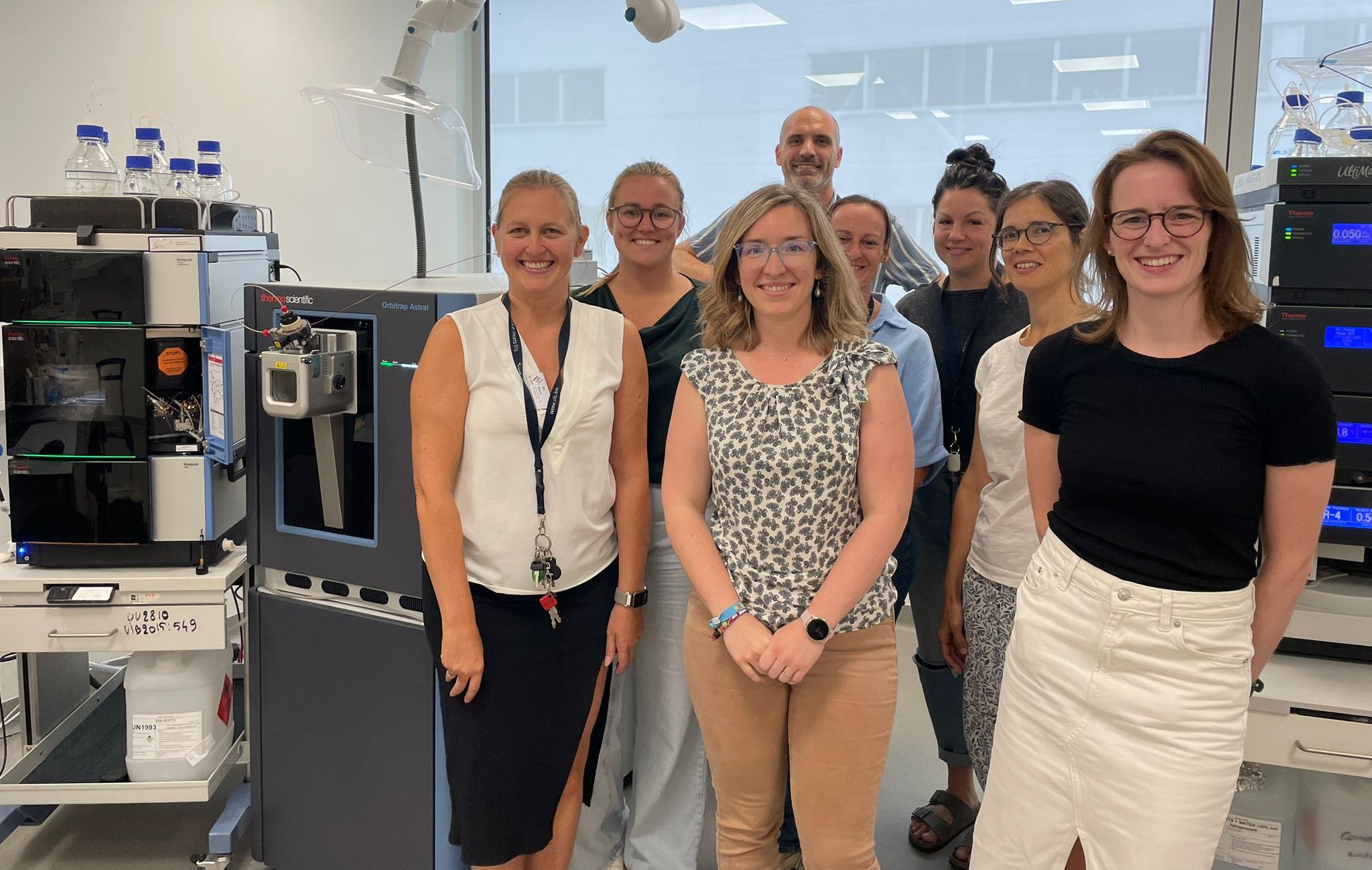
At the center of the upgrade sits the Orbitrap Astral, a newer-generation mass spectrometer from Thermo Fisher that combines two mass analyzers: the established Orbitrap and the novel Astral analyzer. The combination delivers both high sensitivity and fast scan speeds. Paired with the Vanquish Neo, a nano-liquid chromatography system that separates complex peptide mixtures before they enter the mass spec, the setup can run shorter gradients per sample while still achieving deep proteome coverage.
In practical terms, a full 96-sample plate can now be analyzed in about three days. That same workload previously took over a week.
There are immense gains in terms of sensitivity as well. The system can resolve the proteome of a single cell, a measurement that would have been unthinkable not long ago. But no one runs a single-cell experiment on one cell. The power of single-cell proteomics lies in analyzing hundreds of individual cells from one experiment, each one revealing how protein expression varies across a population. And it's exactly where sensitivity and throughput have to work together: you need an instrument sensitive enough to read one cell, inside a pipeline fast enough to do that hundreds of times over.

Data delivery: interactive HTML reports
The core has also rethought how researchers receive their results. Instead of dense Excel spreadsheets, the team now delivers interactive HTML reports that researchers can open in any browser. They can filter by protein, generate plots, and explore specific comparisons on their own terms without complicated scripts and specialized software.
A system ready for the future
The facility now runs seven mass spectrometers, with the Orbitrap Astral and timsTOF Ultra2 as the newest additions. The goal is to push throughput from around 40 samples per day to over 100. That kind of capacity is what opens the door to the large-scale clinical and translational projects that increasingly define where proteomics is heading and positions the VIB Proteomics Core not just for today's research, but for whatever comes next.